How wide? roughly.
Resize one city's outline against another until the built-up area matches.
Every day: Five pairs of cities each day, the same for everyone: resize one city's outline until its built-up area is right next to the other's. New puzzle: Midnight UTC.
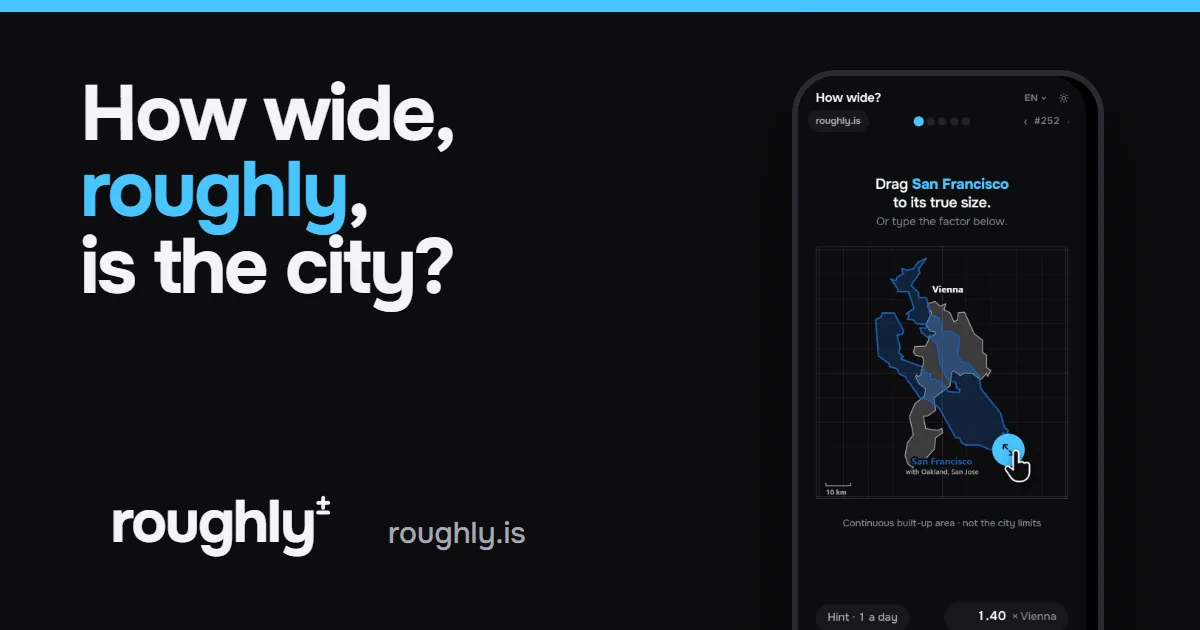
How wide? roughly. lays two city shapes over each other, such as Edinburgh and Hamburg. The grey one is shown at true scale; you drag the other to the size you think its built-up area really is, then see the real area in square kilometres and how many times off you were.
About How wide? roughly.
How wide? is one of the daily guessing games from roughly., a small site where every game asks for an estimate rather than an exact answer. Here the question is how much ground a city covers, measured as its continuous built-up area rather than its official city limits.
Each day brings five pairs of cities, the same for every player, often from different parts of the world: Denver against Ahmedabad, Quito against Melbourne, Brussels against Kyiv. The first city appears as a grey outline at its real size. You drag the second city's outline bigger or smaller over it, or type how many times larger or smaller you think it is. One hint a day tells you the reference city's area and its length at the longest point.
After you lock it in, the game shows both areas in square kilometres, the factor between your guess and the truth, the share of players who got closer, and a short napkin calculation that boxes the city in and estimates how much of the box is built up. The outlines and areas come from the Natural Earth urban areas map, which is based on satellite data, so every city is measured by the same rule. New rounds arrive at midnight UTC. Today's rounds are free and need no account; past days need the paid roughly+ tier. You can challenge a friend or open a room to play together, in English or German.
How to play How wide? roughly.
- Look at the grey outline of the first city, shown at its real size.
- Drag the second city's outline until you think its built-up area is right, or type the factor.
- Press Lock in to see both areas and how many times off you were.
- Read the napkin math, then go on to the next pair.
- After five pairs, share your average miss or challenge a friend.
Tips
- Population is a poor guide: some large cities are packed tight and some smaller ones sprawl.
- Area grows with the square of width, so a city twice as wide covers about four times the ground.
- Only continuous built-up land counts, so a city split by water or open land may be smaller than you expect.
Questions
When does How wide? roughly. reset?
New pairs arrive every day at midnight UTC, five per day, the same for everyone.
What counts as the size of a city?
Its continuous built-up area from the Natural Earth urban areas map, not its official city limits.
How is it scored?
By how many times too big or too small your guess was. The day's result is your average across five pairs.
Is it free?
Yes. Today's rounds are free and need no account. Past days need roughly+.
Games like How wide? roughly.
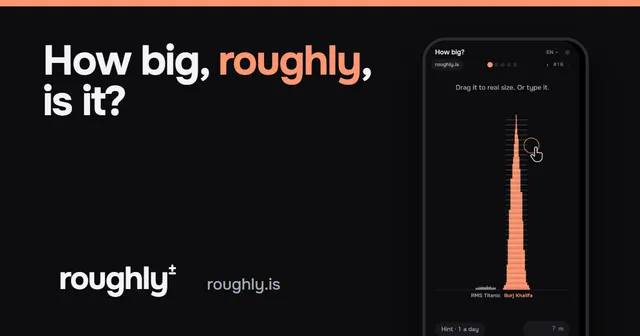
How big? roughly.
The same site's size game with objects instead of cities
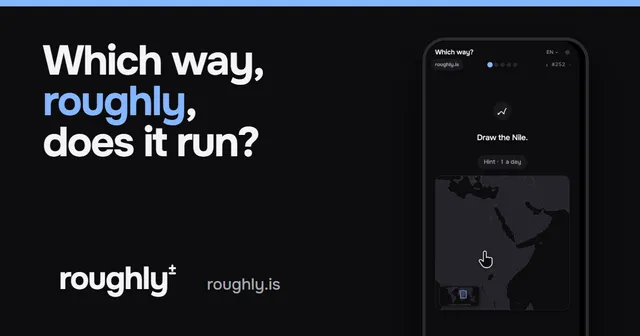
Which way? roughly.
The same site's drawing game: trace rivers and mountain ranges on a blank map

Where? roughly.
The same site's map game: pin five animals where they live

When? roughly.
The same site's timeline game: place five things from history, roughly
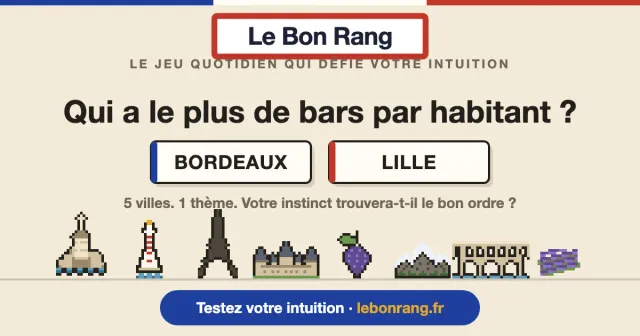
Le Bon Rang
Order five cities by one statistic
Geopolitix
Order five countries by one statistic

How expensive? roughly.
Guess what a kilo of beef or a pound of sugar cost, in a given place and year.
How many? roughly.
Guess how many of you it takes to reach the top of a tower, roughly.