It Took
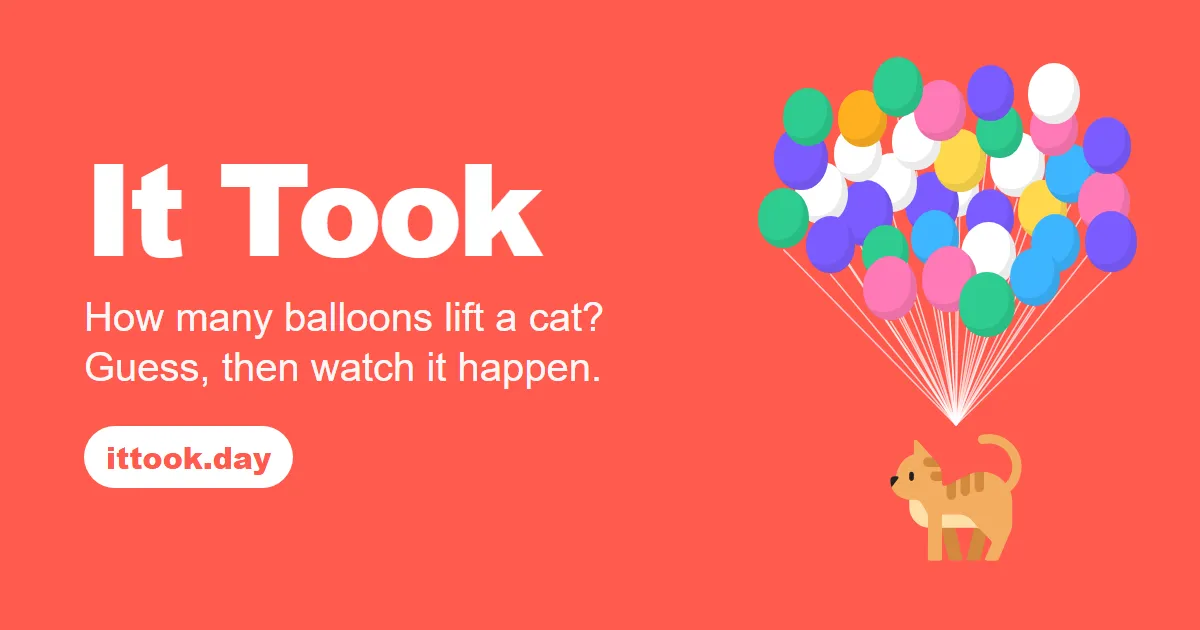
Rate itHow many balloons lift a cat? Guess the number, then watch the experiment run.
Every day: Five new numbered experiments a day, the same for every player: guess how many balloons, batteries, cyclists, ice cubes or the like it takes to make each one work, with three tries each and up to 15 points. New puzzle: Midnight by the player's local date.
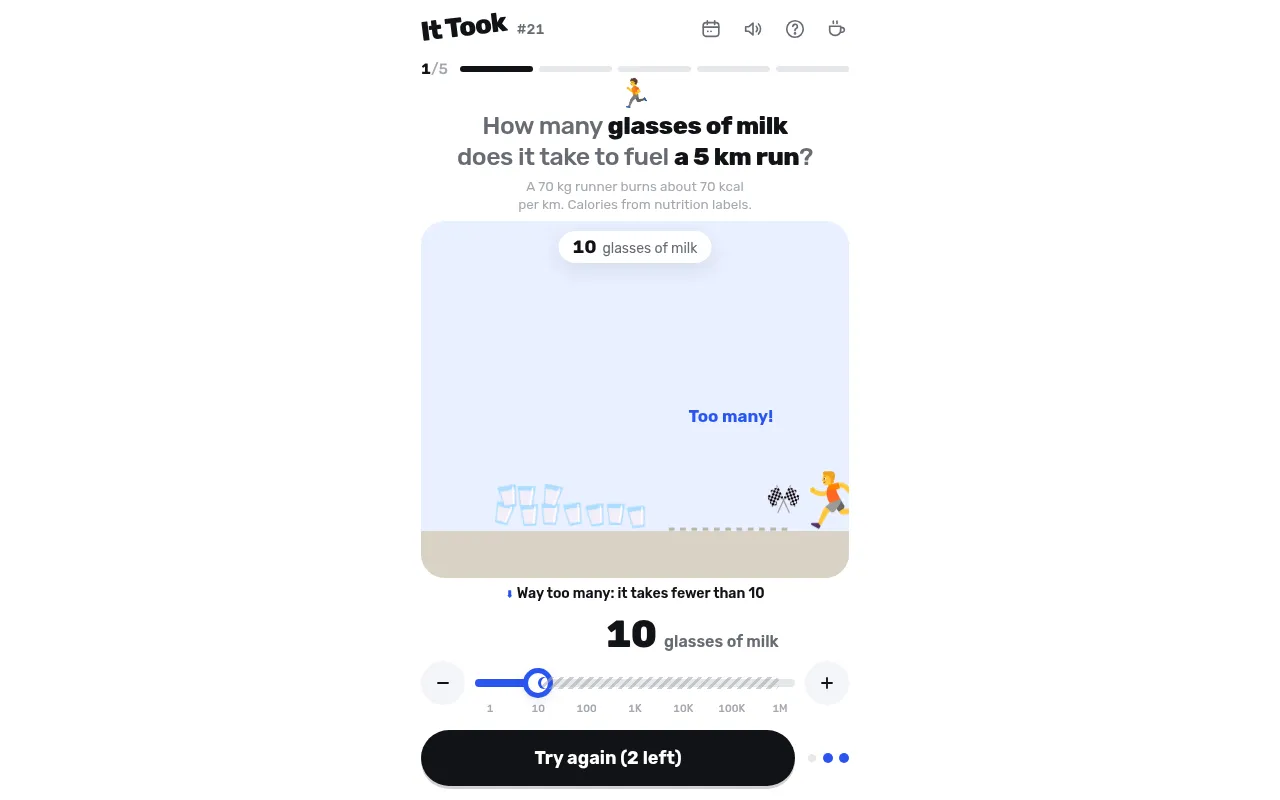
It Took is a daily estimation game of five small physics experiments, such as how many helium balloons lift a cat or how many AA batteries boil a kettle. You set your guess on a slider and the experiment plays out with your number, showing whether it was too few, too many or just right. Three tries per experiment, up to 15 points a day.
About It Took
It Took asks one question five times a day in different forms: how many does it take? One experiment wants the number of helium balloons that would lift a cat, another the number of AA batteries that would boil a kettle, another how many people on bikes it takes to power a toaster or how many ice cubes cool a cup of tea. The game has six kinds of experiment: balloons that lift, batteries, pedal power, ice cubes, running fuel and sugar cubes. Each question states its assumptions under it, such as about 10 g of lift per party balloon or about 3 Wh in an AA battery, so you know what is being counted.
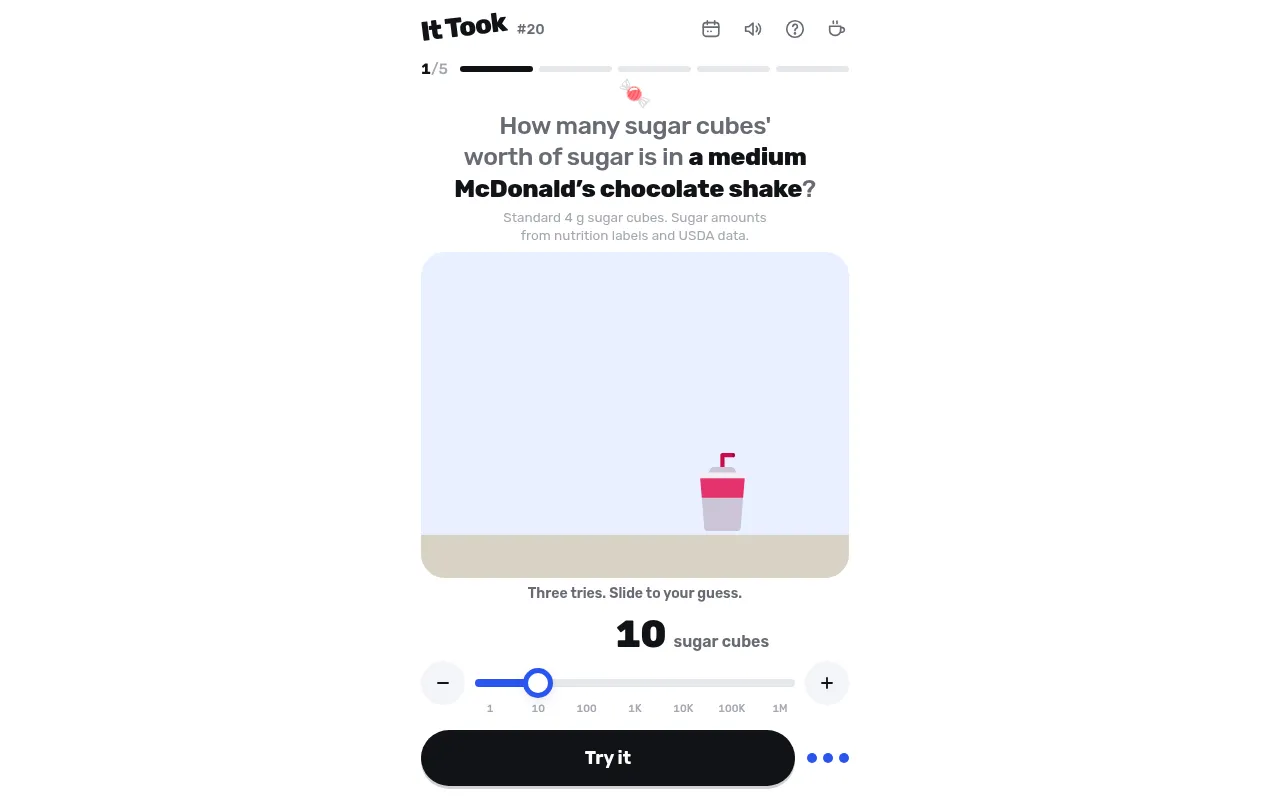
You answer on a slider that runs on a log scale from 1 to a million, with plus and minus buttons to fine tune, or you type the number. Press Try it and the experiment is animated with your number: the cat stays on the ground or floats away, the runner stops short or overshoots the flag. You get three tries, the result of each one tells you which way to move, and the ranges you have ruled out are marked on the slider. A guess within 25 percent of the real amount counts as a hit. A first-try hit scores 3 points, the second 2 and the third 1, so a perfect day is 15, and your total earns a rank from Back to the lab to Mad scientist.
After the fifth experiment you can share a row of coloured squares or send a challenge link so a friend plays the same experiments and you compare totals. A calendar of past experiments keeps every earlier day playable; those count toward your stats but not your streak. The site also has a science page that works through an example of each kind of experiment, and a page of every past answer. The game needs no account.
It Took is made by Faven Games, a small independent studio that also makes Tilt, a daily weighing game. It suits players who like order-of-magnitude guessing and a bit of everyday physics in a short daily session. Unlike estimation games that score how close a single guess lands, It Took gives you feedback and a second and third try, so working toward the answer is part of the game.
How to play It Took
- Open ittook.day and press Play to start today's five experiments.
- Read the question and the assumption printed under it.
- Drag the slider, use the plus and minus buttons, or type a number to set how many you think it takes.
- Press Try it and watch the experiment run with your number: too few, too many or just right.
- Adjust and try again if you missed; you have three tries per experiment, and a guess within 25 percent counts.
- After the fifth experiment, share your score out of 15 or challenge a friend with the same set.
Screenshots
Tips
- Think in powers of ten first: decide whether the answer is in the tens, hundreds or thousands before fine tuning.
- Use the result of a missed try as a bound, then split the difference on the log scale.
- Read the assumption line: it gives the unit size you need for a quick calculation, such as 10 g of lift per balloon or 3 Wh per battery.
- The science page on the site works through one example of each kind of experiment.
Questions
How many puzzles does It Took have each day?
Five experiments a day, the same for every player, each worth up to 3 points.
When does It Took reset?
A new set of experiments starts at midnight by your device's local date.
Can I play past days of It Took?
Yes. The past experiments calendar keeps every earlier day playable. Past days add to your stats but not to your streak.
Do I need an account?
No. It Took plays in the browser with no sign-up. It shows a few ads away from the experiments.
Ratings and reviews
No ratings yet. Be the first to rate It Took.
Games like It Took
Tilt
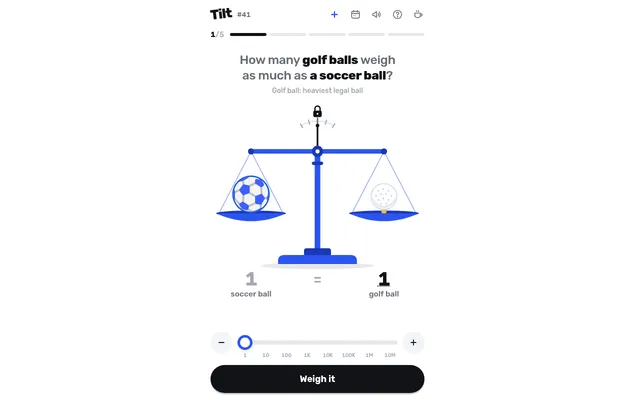
From the same maker: a daily weighing game where you guess how many of one thing balance another.

How many? roughly.
Five objects a day, each a 'how many would it take' guess at the same kind of everyday scale.

Fermi
Daily Fermi questions that reward the same order-of-magnitude reasoning.
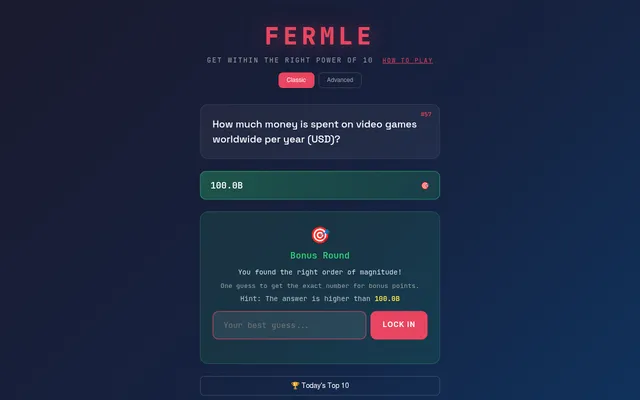
Fermle
One Fermi question a day, worked out from rough numbers as It Took's assumptions invite.
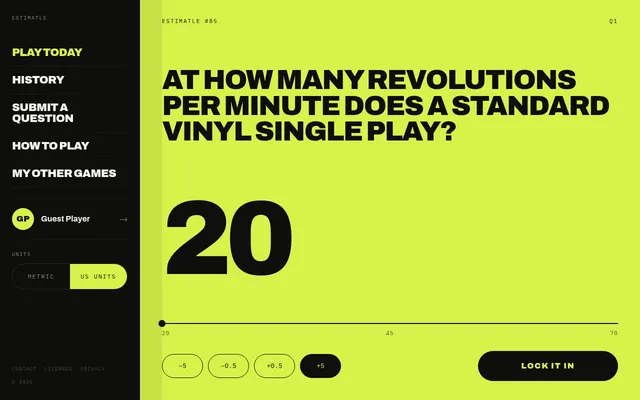
Estimatle
Five numbers a day set on a slider, with closeness scoring instead of tries.
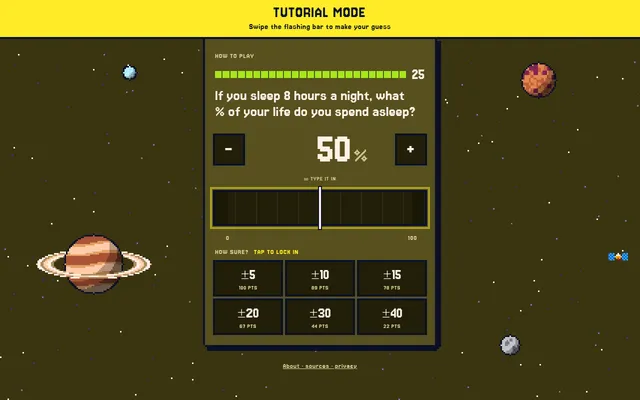
Close Enough
Five real-world quantities a day, guessed against a timer with a range.
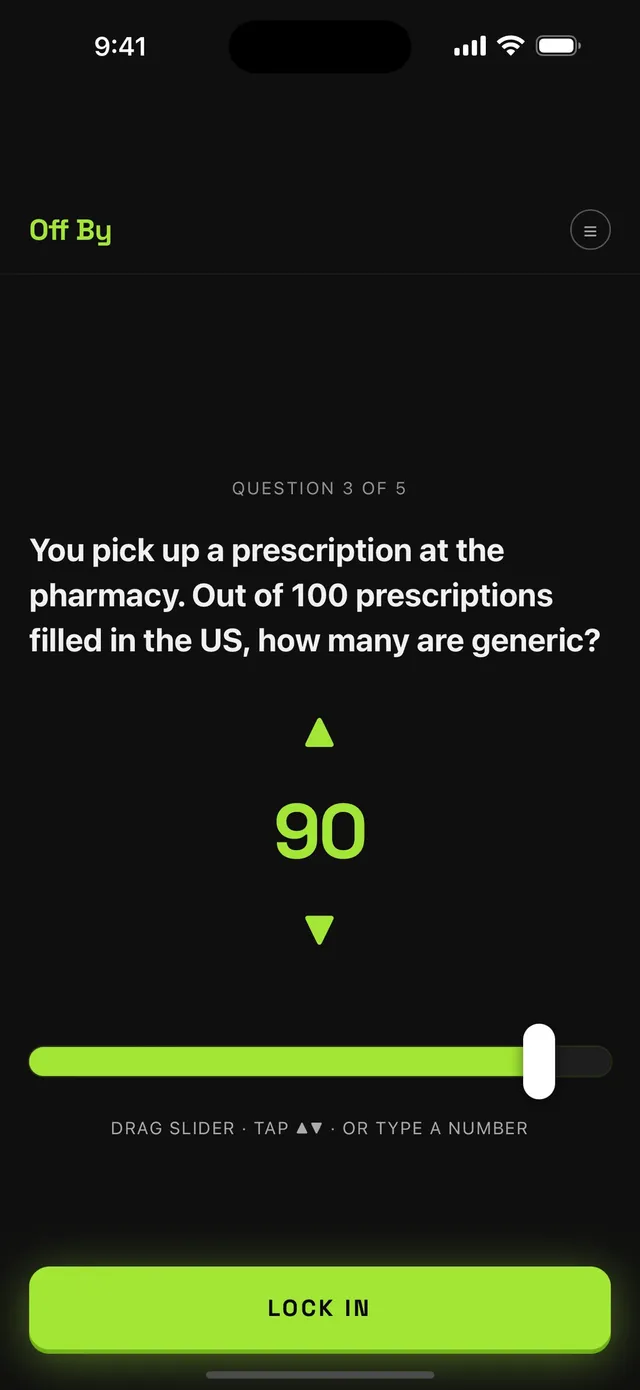
Off By
Five quick guesses a day about the numbers behind real life, and how far off you were.
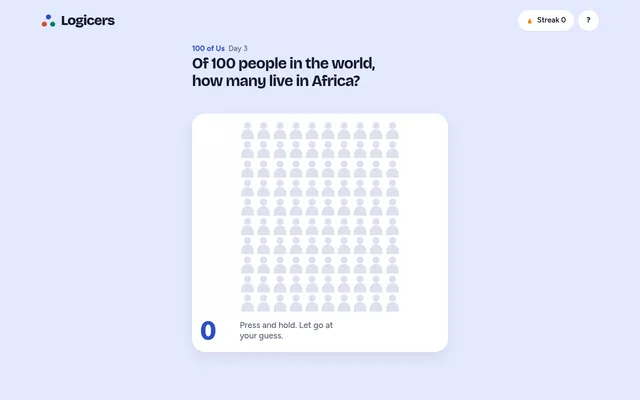
100 of Us
Of 100 people in the world, how many? One guess a day.