OpGlyph
Fill the operator blanks between fixed digits so the line, read left to right, hits the target.
Every day: A dated row of digits and a target for each level (Easy, Medium, Hard), the same for everyone, where you fill the blanks with + - × ÷ so the line, worked strictly left to right, hits the target, in six tries. New puzzle: Midnight UTC.
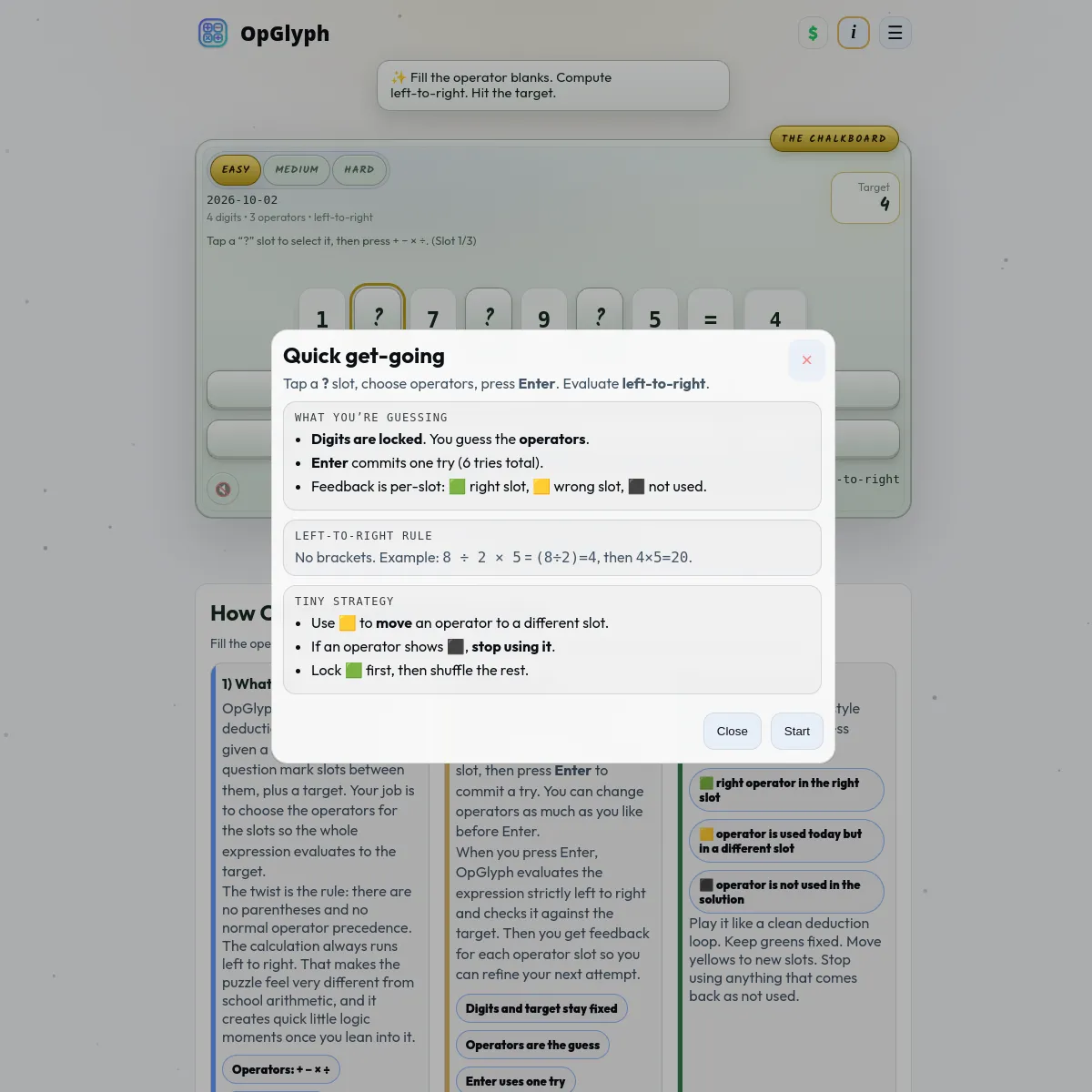
OpGlyph is a daily operator puzzle from the Glyphverse collection behind NumberGlyph. The digits and target are fixed; you guess which operators go in the blanks, with Wordle-style feedback on each slot and six tries. The catch is that everything is worked out left to right, with no brackets and no usual precedence.
About OpGlyph
Each OpGlyph puzzle shows a line such as 1 ? 7 ? 9 ? 5 = 4. The digits never move; your job is to choose an operator for every question mark from plus, minus, times and divide so that the whole expression equals the target. Unlike school arithmetic, there is no operator precedence and no brackets: the calculation always runs strictly from left to right, so 8 ÷ 2 × 5 is 20.
When you commit a try, each slot gets feedback: green for the right operator in the right slot, yellow for an operator that is used today but in a different slot, and dark for an operator that is not in the solution. You have six tries to find the exact set.
There are Easy, Medium and Hard puzzles each day, with more digits and slots as the level rises. Puzzles are served by date and are the same for everyone; they change at midnight UTC. OpGlyph is part of the Glyphverse, a set of daily and quick-play games by a developer named Sean on numberglyph.com.
It suits players who enjoy Nerdle-type arithmetic puzzles and like a short deduction loop.
How to play OpGlyph
- Choose Easy, Medium or Hard for today's puzzle.
- Tap a ? slot and press + − × ÷ to fill it; fill every slot.
- Press Enter to commit a try; the line is worked out strictly left to right and compared with the target.
- Use the slot colours (green right slot, yellow wrong slot, dark not used) to refine your next try, within six tries.
Tips
- Always calculate left to right: the running total after each step is what matters.
- Lock greens first, then move yellows to other slots.
- Stop using any operator that comes back dark.
- Work backwards from the target: which last step could produce it from a sensible running total?
Questions
Does OpGlyph use normal operator precedence?
No. Expressions are always evaluated strictly left to right, with no brackets.
Is OpGlyph the same for everyone?
Yes. Each level has one puzzle per date for all players.
How many tries do I get?
Six per puzzle.
Games like OpGlyph
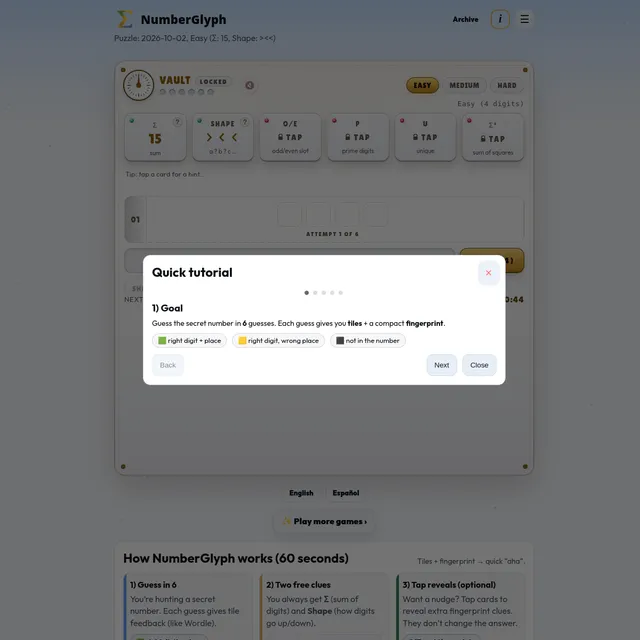
NumberGlyph
A sibling from the same site: crack the day's hidden number in six tries.
MakeTen
Includes a daily round of finding the missing operators to make the numbers work.
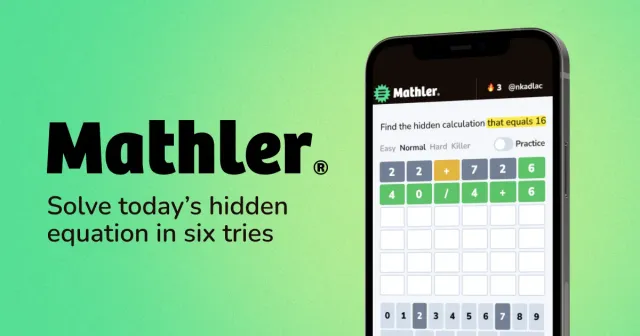
Mathler
Find the equation that produces the day's answer in six tries.
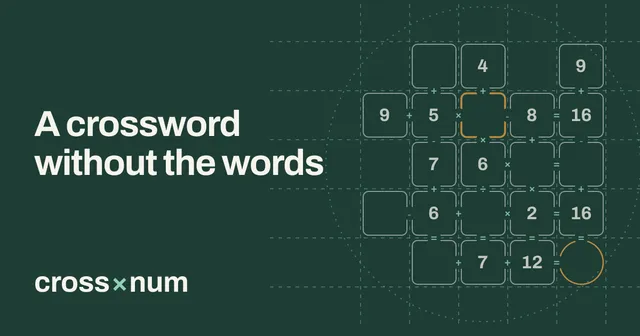
Crossnum
Fill a grid of interlocking equations by pure deduction.
Mathdle
Reach the day's target by combining numbers with the four operations.
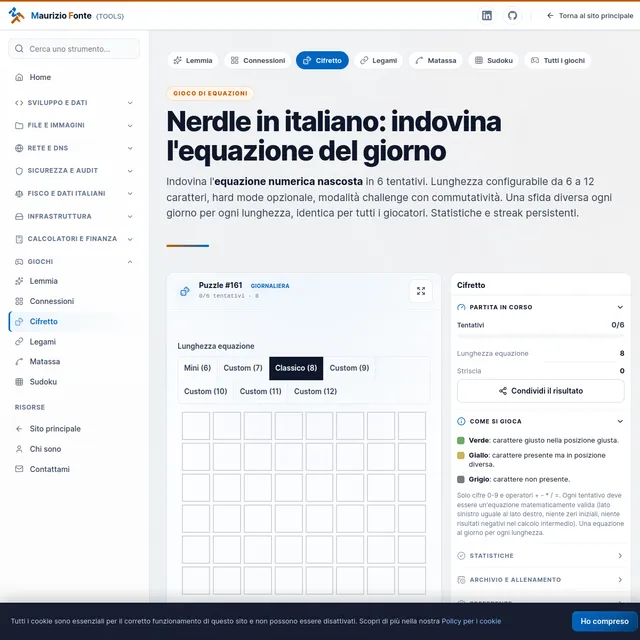
Cifretto (mauriziofonte.it)
Guess the hidden equation in six tries, at several lengths.
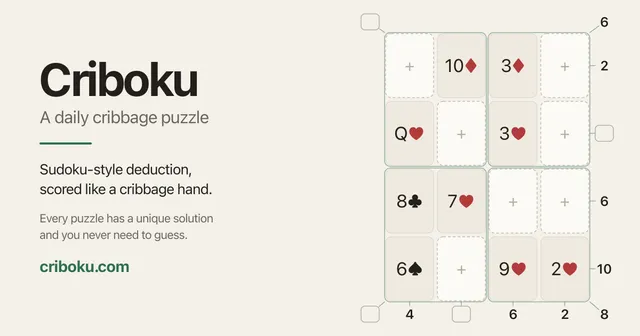
Criboku
Sudoku-style deduction on a grid of playing cards, scored like cribbage hands.
Luckle
Roll until you hit the number of the day, three times, and see how lucky you are compared with everyone else.