Pour
Rate itMark where the liquid will settle when one glass is poured into another, five times a day.
Every day: Five new pours each day, the same for every player: the left glass is emptied into the right one and you mark where the liquid will settle. Each pour scores up to 100 points, 500 for the day. New puzzle: Midnight in the player's own time zone (the countdown runs to local midnight).
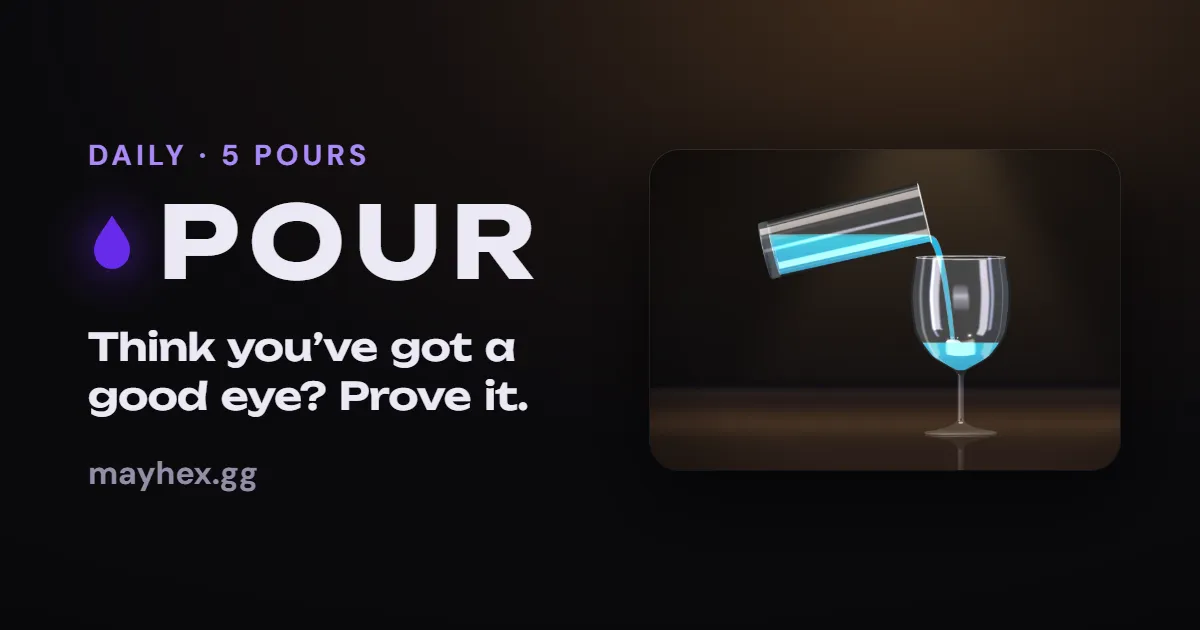
Pour is a daily estimation game from mayhex.gg. Each day brings five pours: the drink in the left glass goes into the right one, and you drag a line to where you think it will settle. Odd glass shapes make volume hard to judge, and a near miss still earns points out of 100.
About Pour
Pour is a browser game from mayhex.gg, the small site that also runs Babushka, Span and Truth Sweeper. Its first daily puzzle, Pour #1, went out on 1 October 2026, and every day since has had its own numbered set of five rounds that is the same for everyone.
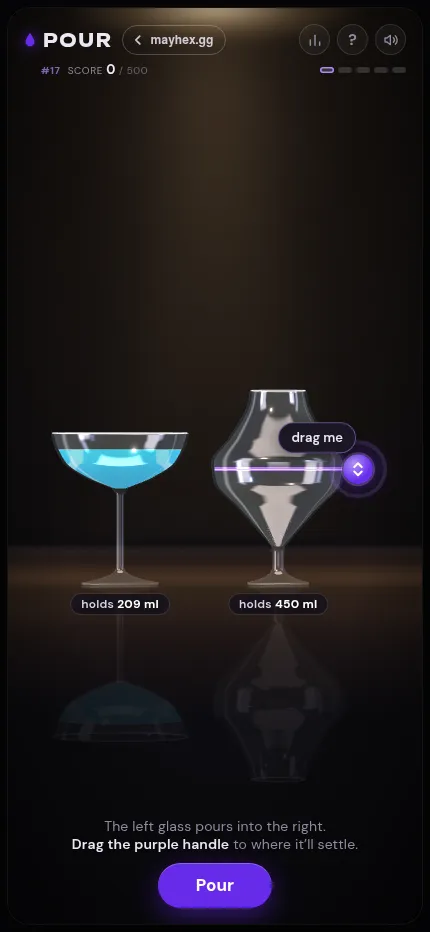
Each round shows two glasses side by side in 3D, each labelled with what it holds in millilitres. The left one is partly full. You drag a purple handle up or down the right glass to the height where you think its contents will end up, then press Pour and watch the liquid run across. Coupes, tumblers, wine glasses and bulbous carafes all appear, and the game warns that odd shapes hold more or less than they seem, so a glass that looks half full by height may be far from half full by volume.
You can turn the scene around and pinch to zoom, and everything is drawn to the same scale in every round. Scoring measures the gap between your line and the true level as a share of the glass's height, so tall and short glasses are judged fairly, and a dead-on guess is marked as a Perfect Pour. After the fifth round you get a total out of 500, a row of result tiles to share, your streak and stats, and a countdown to the next day's set.
Pour suits players who like the eye-test kind of daily game, where there is nothing to know in advance and the only skill is judging space. It plays in a phone browser held upright as well as on a computer, with no sign-up.
How to play Pour
- Open mayhex.gg/pour in a browser; on a phone, hold it upright.
- Look at the two glasses: the left one is full to some level and will be poured into the right one. Each shows how many millilitres it holds.
- Drag the scene to look around the glasses and pinch to zoom if you want a closer view of their shape.
- Drag the purple handle on the right glass to the height where you think the liquid will settle.
- Press Pour and watch: your line is compared with the true level and scored out of 100.
- Repeat for all five pours, then share your total out of 500 and check your streak.
Screenshots
Tips
- Think in volume, not height: a glass that flares out at the top holds much of its volume near the rim, so the level rises slowly there.
- Compare the millilitre labels first: if the right glass holds about twice as much, the poured liquid fills a little under half of it by volume.
- Turn the scene to see each glass from the side; a bulge or a narrow waist is easier to judge from a low angle.
Questions
When does a new Pour come out?
At midnight in your own time zone. The end screen shows a countdown to the next set.
How many rounds are there a day?
Five pours, each worth up to 100 points, for 500 in all.
Do I need an account?
No. The day's game plays straight away in the browser and your streak and stats are kept on your device.
How is a pour scored?
By how far your line is from where the liquid really settles, measured as a share of the glass's height. A guess that lands right on the level is a Perfect Pour.
Ratings and reviews
No ratings yet. Be the first to rate Pour.
Games like Pour
Gauge (Yuki Games)
Five daily eye tests, one of which asks you to pour a glass to a set percentage.
Amountle
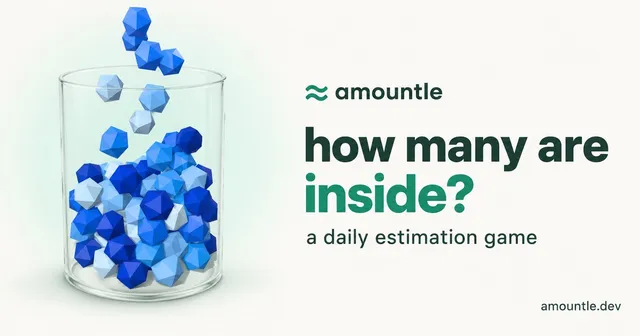
Another daily estimate of what fits in a container: objects pour into a jar and you guess how many.

Keel (Yuki Games)
Quick daily rounds that test your eye for balance, halves and symmetry.
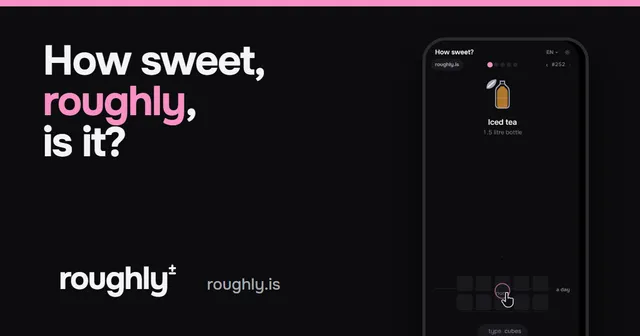
How sweet? roughly.
Judge a quantity in a glass or bowl by eye, scored by how close you come.
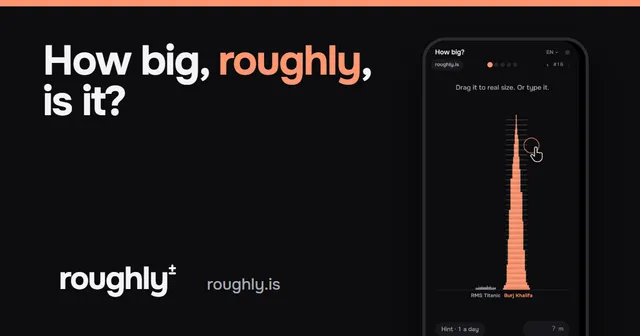
How big? roughly.
Five daily rounds of judging size against a reference by dragging, like setting Pour's line.

Tilt
A daily physical-intuition puzzle: balance a scale by eye rather than by knowledge.
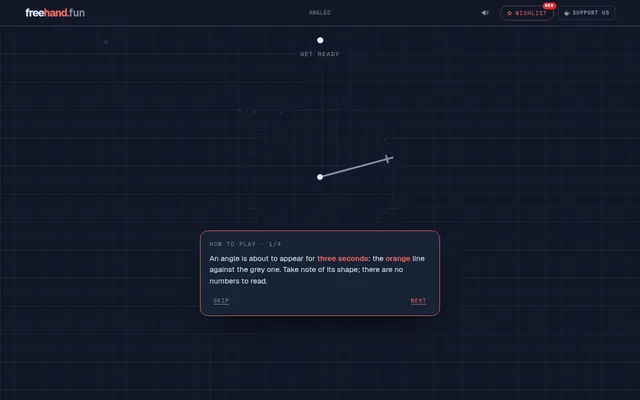
Angled
See an angle for three seconds, then rebuild it from memory on a dial.
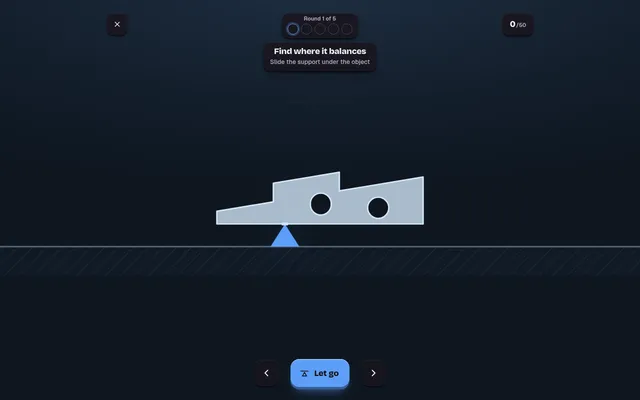
Balanced (Freehand)
Slide the support under an uneven shape to where it will hold level, five shapes a day.