Every Beat
Rate itSet how fast one animal's heart beats today, then see the real one beat beside it.
Every day: One real animal a day, caught doing one thing (resting, diving, flying, hibernating), the same for everyone. You guess how fast its heart beats, from 1 to 2,000 beats a minute. New puzzle: Midnight (the game says a new heart arrives at midnight).
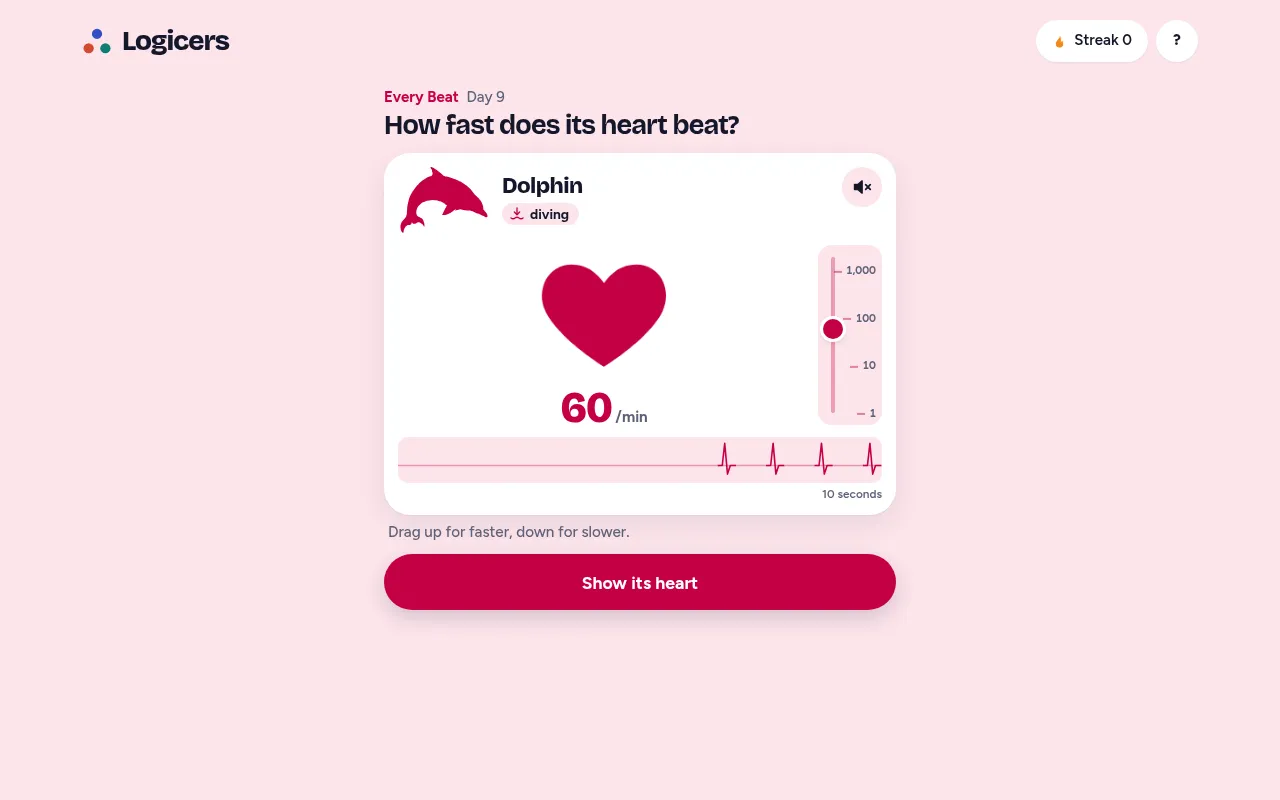
Every Beat is a daily estimation game from Logicers. Each day it shows one real animal doing one thing, such as a dolphin diving, and you set how fast you think its heart beats. Then the real heart beats beside yours, with the measured figure and where it comes from.
About Every Beat
Every Beat is a small daily game on Logicers, a site of short learning games. Each day brings one animal and one activity: a dolphin on a dive, a bird in flight, a mammal in hibernation. Your job is to guess its heart rate in beats per minute.
The heart in the middle of the card starts at 60 beats a minute, about a resting human heart, and beats on screen as you change it. You drag up to make it faster and down to make it slower, or slide the scale on the right, which runs from 1 to 2,000 beats a minute on a logarithmic scale. A trace underneath shows ten seconds of beats, and a speaker button lets you hear the rhythm.
When it feels right you press Show its heart. The real heart appears next to yours, and the game tells you how many times too fast or too slow you were. Anything within about 15 percent of the measured figure counts as spot on, since a real heart's pace moves from minute to minute. Each figure was measured by scientists, vets or doctors and checked on two websites, both linked under the answer.
Each day you play adds a stamp to an album, and the game keeps a streak, all stored in your own browser with no login and no cookies. A share card shows the animal and how far off you were without giving away the answer. It suits anyone curious about animals and biology who wants a one-minute guess a day.
How to play Every Beat
- Read today's animal and what it is doing, for example a dolphin diving.
- Drag the heart up to make it beat faster or down to make it slower, or move the slider on the right between 1 and 2,000 beats a minute.
- Watch the trace or tap the speaker to hear the beat until the pace feels right.
- Tap Show its heart to see the real heart rate beside yours and how many times off you were.
- Share your result card, and come back after midnight for the next animal.
Tips
- Small animals usually have much faster hearts than large ones, so start from the animal's size.
- Activity matters: a diving or hibernating animal slows its heart well below its resting rate, while flight speeds it up.
- The scale is logarithmic, so think in factors of ten first and fine-tune after.
- You only need to be within about 15 percent of the figure to count as spot on.
Questions
When does Every Beat get a new animal?
A new heart arrives each day at midnight, and it is the same animal for everyone that day.
Do I need an account to play Every Beat?
No. There is no login; your streak and stamp album are kept only in your browser.
Where do the heart rates come from?
Each figure was measured by scientists, vets or doctors and read on two websites, which are linked under the answer.
Can I play earlier days?
A Practice mode lets you try yesterday's heart. It does not count toward your streak or album.
Ratings and reviews
No ratings yet. Be the first to rate Every Beat.
Games like Every Beat

100 of Us
Another Logicers daily estimate: guess how many of 100 people in the world fit a fact.
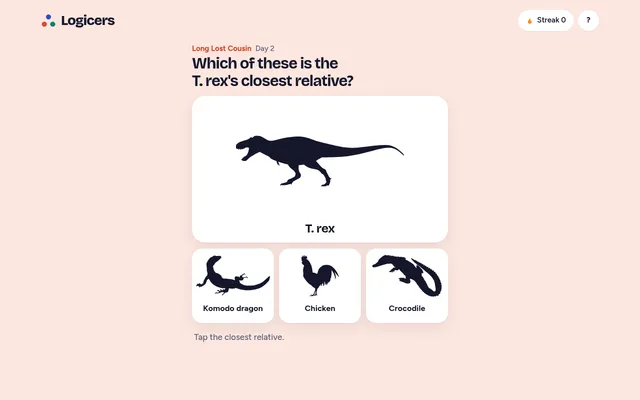
Long Lost Cousin
Logicers' daily animal game: pick which of three animals is the closest relative of a fourth.

Metazooa
For animal lovers: find the mystery animal by climbing the tree of life.
Acrobeat
Also about rhythm and timing: hear the gap between two beeps and tap it back each day.
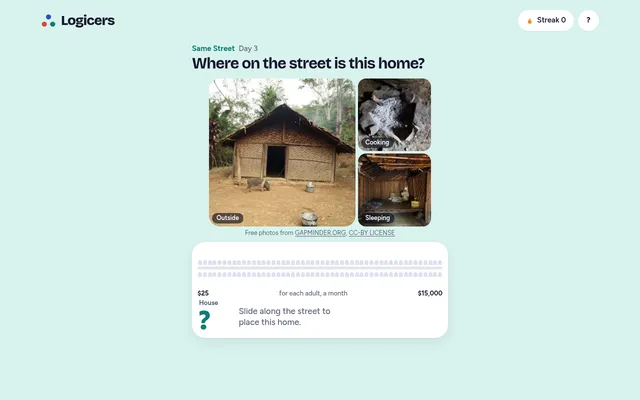
Same Street
Logicers again: estimate where a real home sits on a street sorted by income.
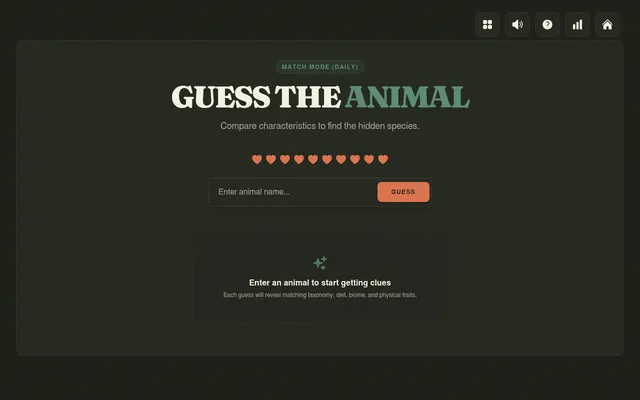
Animaldle
Guess the animal of the day from how your guesses compare on traits and taxonomy.

Airspan (FlightQ)
Resize a plane or airport against a known object until the scale looks right.
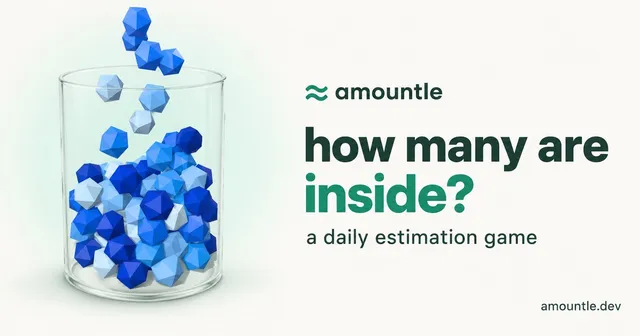
Amountle
Watch objects pour into a jar and guess how many, five times a day.