The Ballpark
Rate itFive percentage questions, one pie: split it between the answers, which always add up to 100%.
Every day: Five percentage questions a day, the same for everyone, whose answers add up to exactly 100%; you split one pie between them. Puzzles are numbered from #1 on 2 October 2026 (#6 on 7 October), with a crowd score curve and a monthly leaderboard. New puzzle: Midnight, local time.
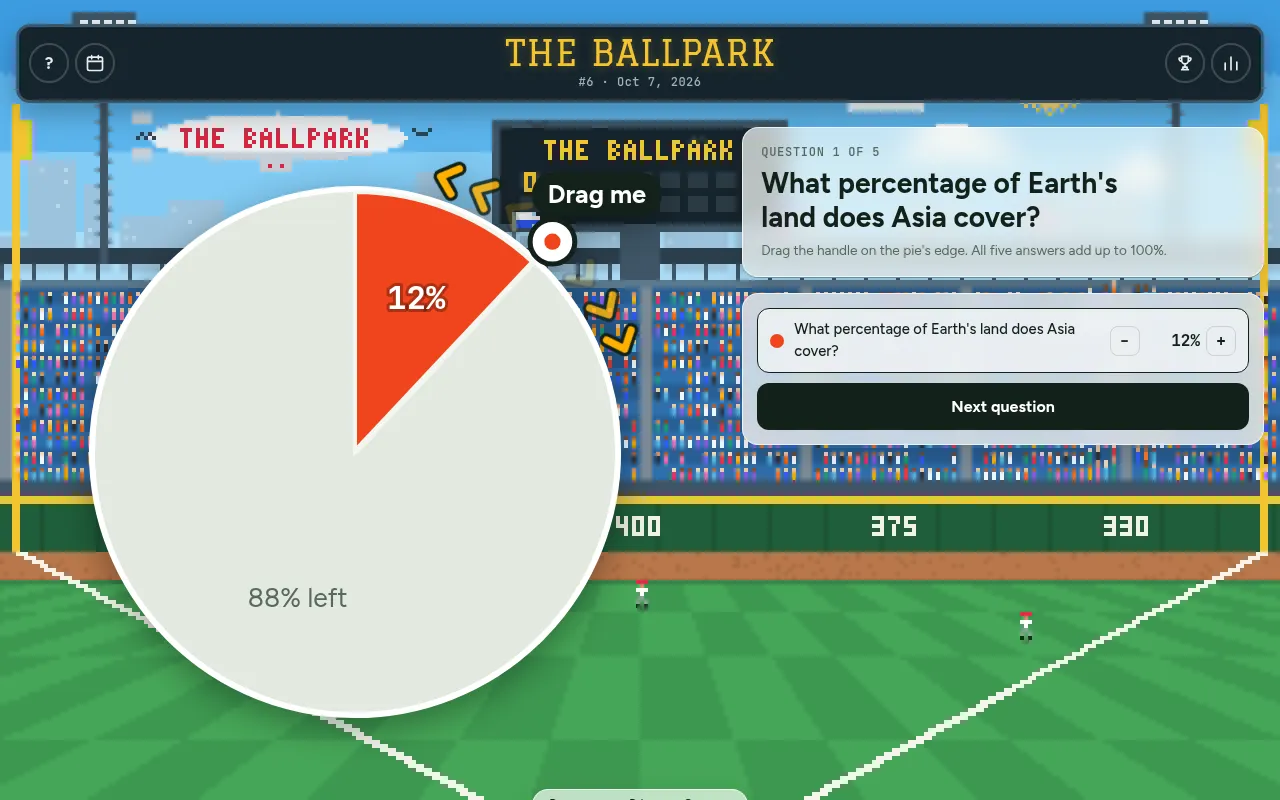
The Ballpark is a daily estimation game with five questions whose answers are percentages that add up to 100%. You size one slice of a single pie for each, so every guess takes from the others, and your accuracy is scored as a baseball hit from Single to Home run.
About The Ballpark
The Ballpark asks five questions each day, and every answer is a percentage. The twist is that the five answers always add up to exactly 100%, so you are not guessing each number on its own: you are dividing one pie between them.
You drag a handle on the edge of the pie, or use the minus and plus buttons, to size a slice for the first question, then the next slice comes out of what is left. You can go back and resize an earlier slice while the others keep their size, and the last answer gets whatever remains. Questions on one day might cover how much of Earth's land Asia covers, the share of the world's people who live in India or Africa, and how much land is forest.
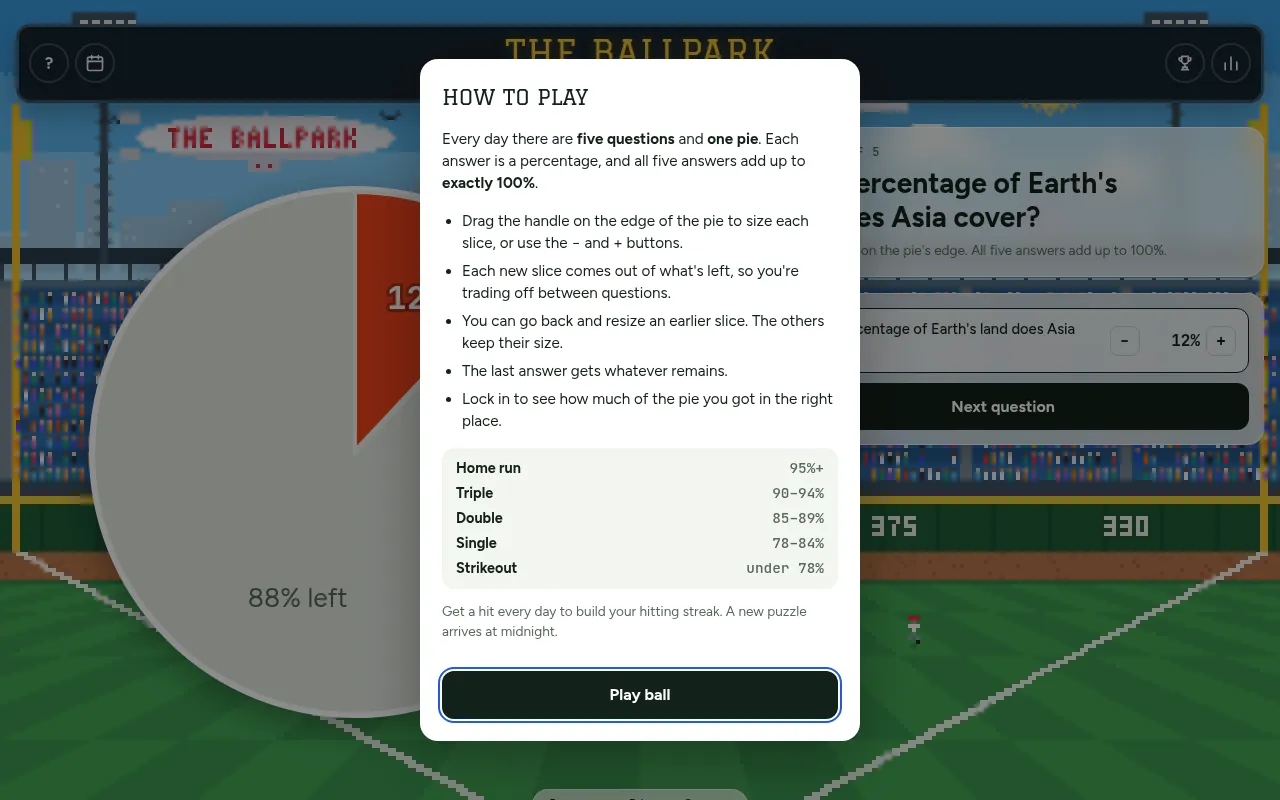
When you lock in, an outer ring shows the real answers around your guesses, each with a short fact, and the game tells you what percentage of the pie you put in the right place. 95% or more is a Home run, then Triple, Double and Single down to 78%, and anything lower is a Strikeout.
Getting a hit every day builds your hitting streak. A curve shows how everyone scored on the day, and if you make a free account your first go at each daily puzzle counts toward a monthly leaderboard. Past games can be replayed from the calendar, though replays do not count.
How to play The Ballpark
- Open theballpark.io and press Play.
- Read the first question and drag the pie handle, or use minus and plus, to size its slice as a percentage.
- Press Next question; each new slice comes out of what is left of the pie.
- Go back and adjust any slice if a later question changes your mind; the last answer takes what remains.
- Lock in to see the real answers, your accuracy and your hit, then share it.
Screenshots
Tips
- Read all five questions before sizing the first slice, since one large answer squeezes the rest.
- The last answer is forced, so save the question you know least for the end.
- Questions often overlap (a country inside its continent), so keep the parts smaller than the whole.
- Accuracy is 100 minus half your total error, so a slice 5 points too big that leaves another 5 too small costs you 5 points.
Questions
Do the answers in The Ballpark always add up to 100%?
Yes. Every day the five answers add up to exactly 100%, which is why they share one pie.
When is there a new puzzle?
At midnight, local time. A note after you finish counts down to the next one.
What counts as a home run?
Putting 95% or more of the pie in the right place. Triple is 90 to 94, Double 85 to 89, Single 78 to 84, and below that is a Strikeout.
Can I play earlier puzzles?
Yes. Past games open from the calendar, but replays do not count toward your stats or the leaderboard.
Ratings and reviews
No ratings yet. Be the first to rate The Ballpark.
Games like The Ballpark

Piecemeal (GuessDash)
Drag pie slices to guess how real-world totals are split.
Breakdown
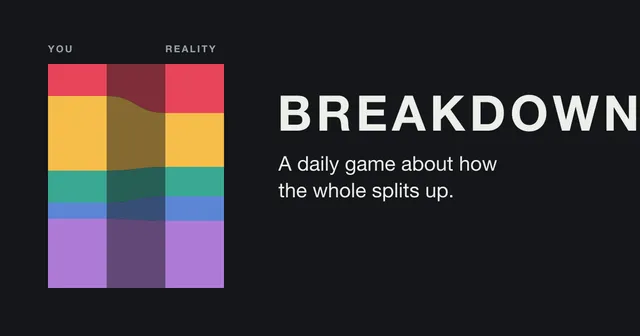
Guess how a real total splits into slices, then see the true shares.
HUNDO
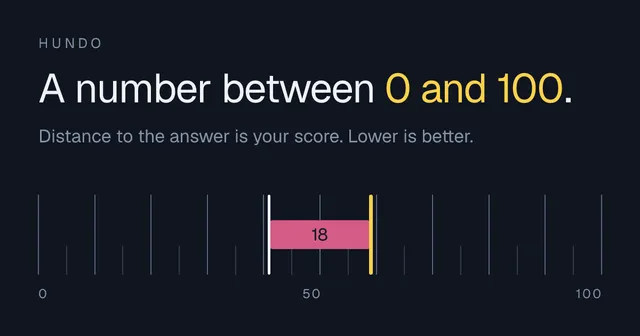
Five questions a day with answers from 0 to 100, scored on how close you get.

100 of Us
Guess world shares as numbers out of 100 people.
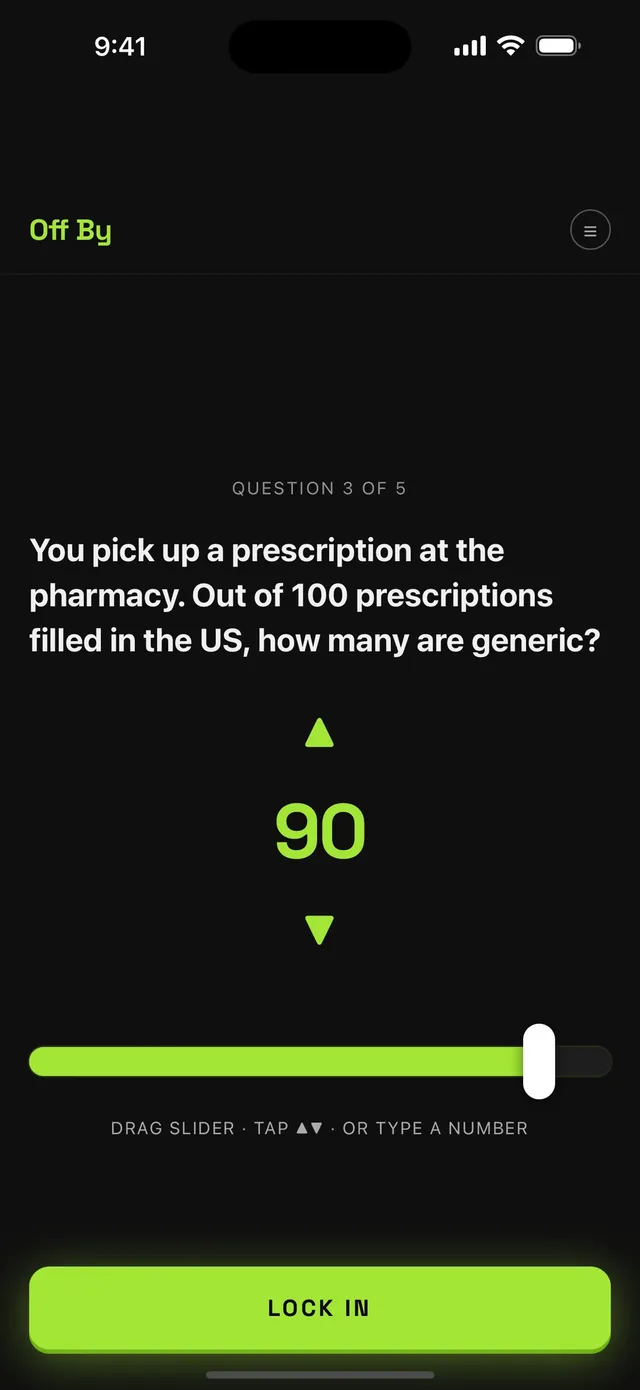
Off By
Five quick daily guesses about the numbers behind real life.
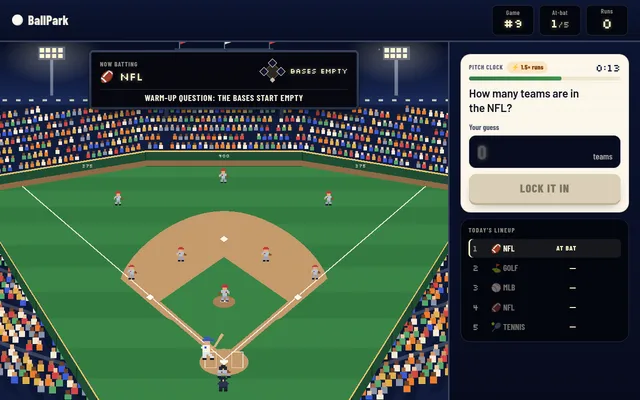
Ballpark (ballparkplay.com)
Five number questions a day dressed as baseball at-bats, scored by how close each estimate lands.
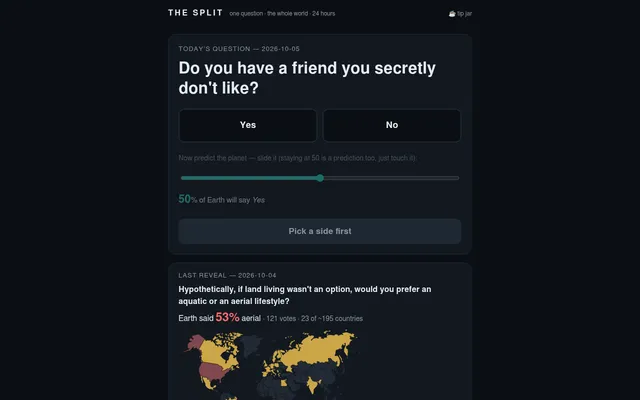
The Split
Another daily game about how the world divides, predicting how players split.
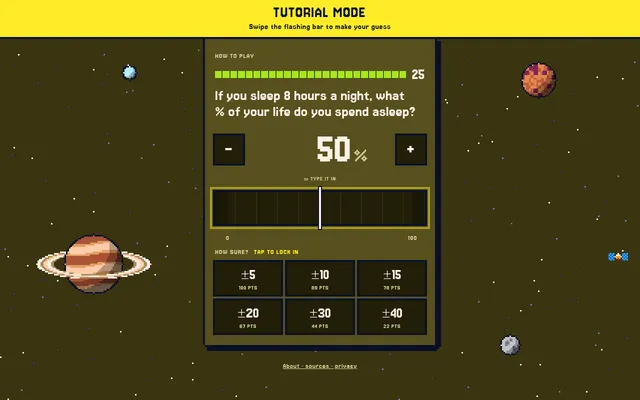
Close Enough
Five real-world numbers a day, 25 seconds each: pick a guess and a range, and tighter ranges score more.