Modus Ponens
Rate itLight each room by proving it: a daily puzzle of pure propositional logic.
on modusponens.app
Modus Ponens is a minimalist daily puzzle game built on intuitionistic propositional logic. Each level is a map of rooms, every room a proposition, and you light a closed room by touching the rooms that prove it. Solving a puzzle quietly proves a formula, which is kept as a trophy.
About Modus Ponens
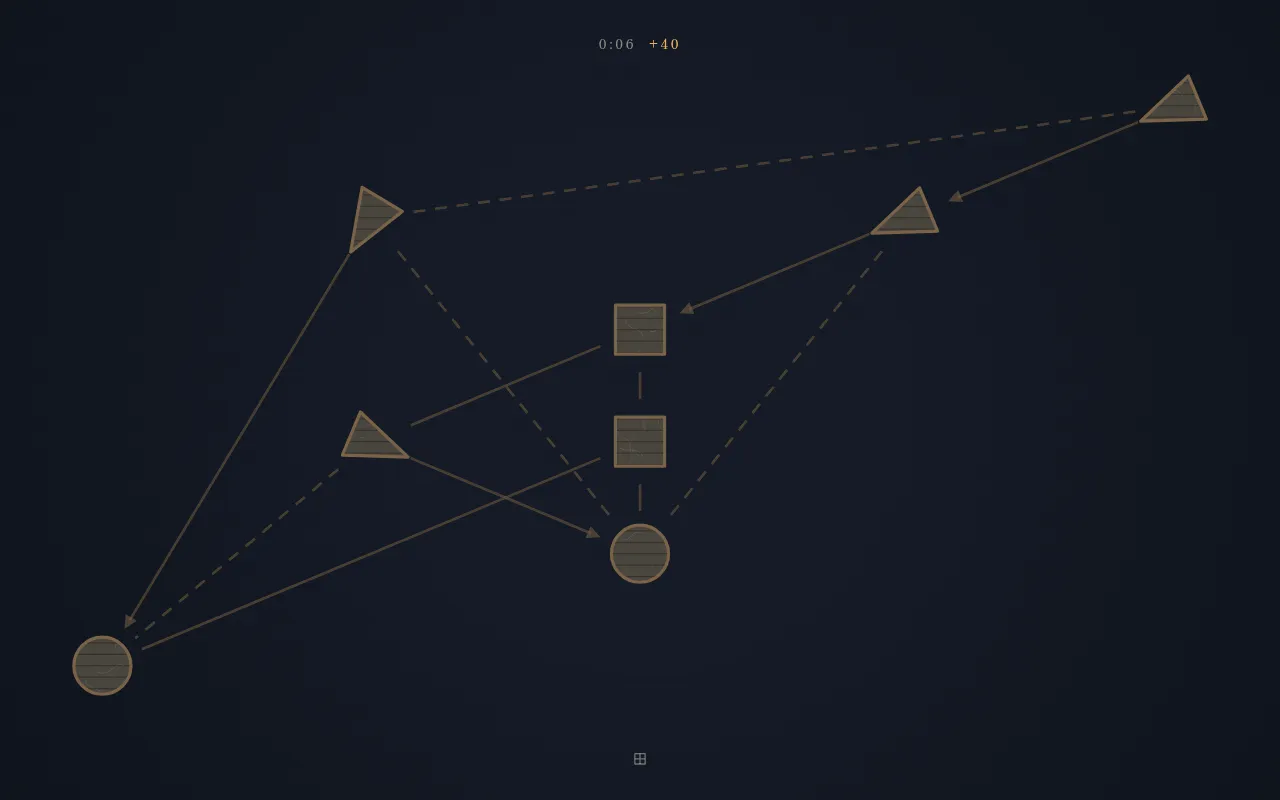
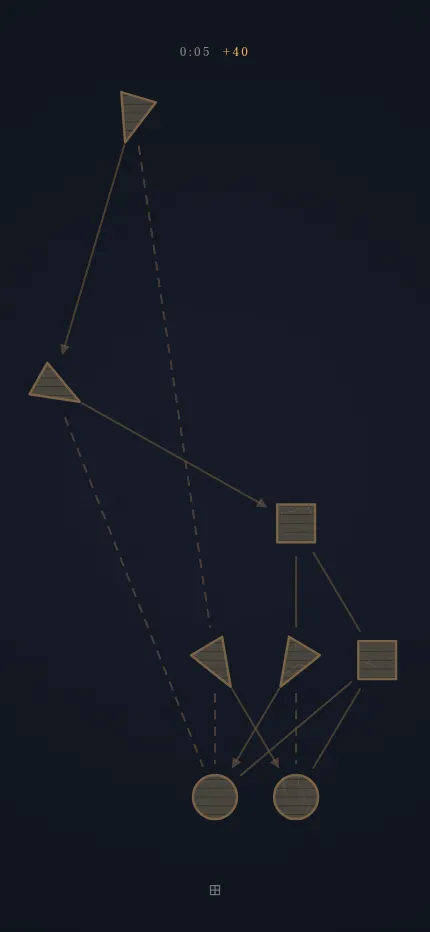
Modus Ponens turns logical proof into a quiet puzzle of light and rooms. Each level is a map in which every room stands for a proposition, and the shapes of the rooms' outlines stand for the connectives. To solve it you choose a closed room as your goal and then touch the rooms that prove it; a proven room lights up. Implications are proved inside a hypothetical space where the premise is assumed, and a fork splits a proof into two cases.
The logic is intuitionistic, and the game says so plainly: the law of the excluded middle does not hold, so some rooms never open however you try. Each puzzle you solve is secretly a theorem, and the Trophies page keeps every one with the formula you proved, such as the A, A implies B, therefore B on its title card.
The Daily mode serves one new puzzle every day, the same for everyone, numbered from its start on 25 September 2026. Classic mode deals puzzles one after another at random or at a chosen difficulty from 1 to 8, and How To is a guided sequence that brings in one connective at a time. A timer runs on the daily, and a fast proof earns a bonus that counts toward the monthly and all-time rankings on the Trophies page. A solved proof can be shared as a short text with its number and formula. It is free in the browser with no account, and suits anyone curious about logic as well as players who like abstract, wordless puzzles.
How to play Modus Ponens
- Start with How To if you are new: it introduces one connective at a time.
- Open Daily for the day's puzzle, a map of rooms that each stand for a proposition.
- Choose a closed room as your goal.
- Touch the rooms that prove it; enter an implication's room to assume its premise, and split a fork into its two cases.
- Light the goal room to finish, and find the proved formula in your Trophies.
Screenshots
Tips
- Read each room's outline: its shape tells you which connective it stands for and how it can be proved.
- Do not try to prove a statement from its own negation's failure: the excluded middle does not hold here.
- When a fork appears, prove the goal in both cases separately.
- Use Classic at a low difficulty to learn the connectives before the daily puzzle.
Questions
Do I need to know logic to play Modus Ponens?
No. The How To sequence teaches the rules one connective at a time, and the puzzles are played with rooms and light rather than symbols.
Why will some rooms never open?
The game uses intuitionistic logic, where the law of the excluded middle does not hold, so some classically true statements cannot be proved.
Is there a new puzzle every day?
Yes. Daily mode gives one new puzzle each day, the same for everyone.
Can I play more than the daily?
Yes. Classic mode serves puzzles at random or at a difficulty from 1 to 8.
Is there a leaderboard?
Yes. Solved puzzles earn points, with a bonus for speed, and the Trophies page ranks players by month and of all time. You can hide yourself from the board.
Ratings and reviews
Games like Modus Ponens
Gatelit (Dayzle)
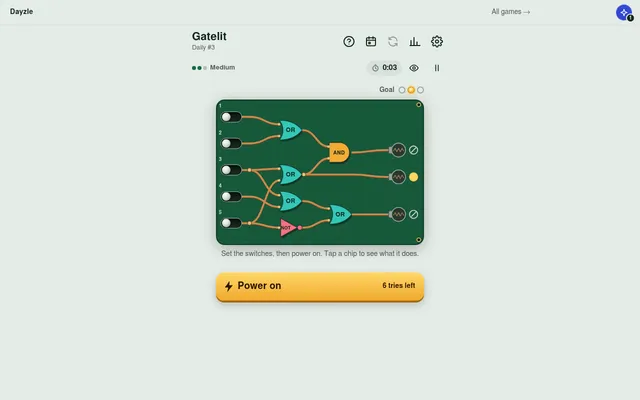
Another daily built on logic connectives. Here AND, OR, NOT and XOR gates feed lamps, and you find the switch…
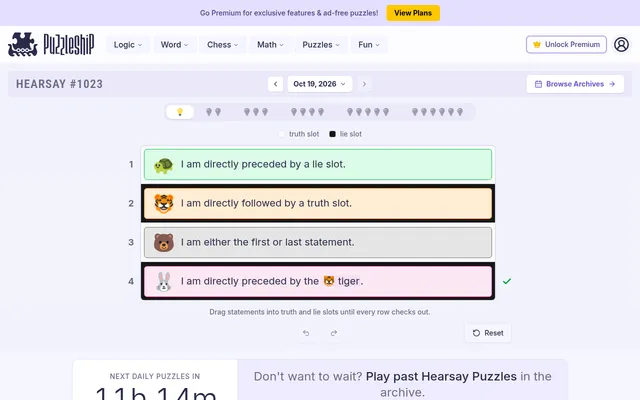
Hearsay (Puzzleship)
Self-referential statements sorted into truth and lie slots, six graded puzzles a day.
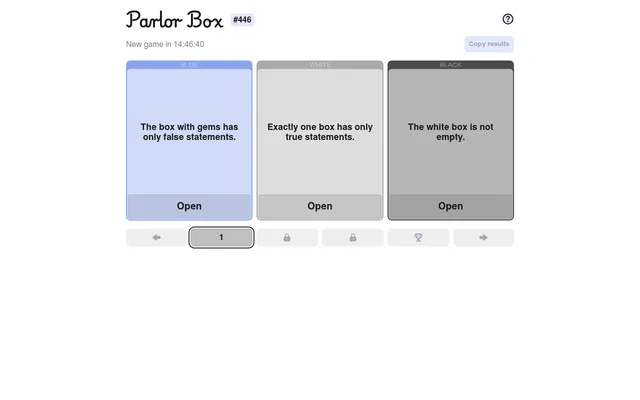
Parlor Box
Deduce which box holds the gems from statements that may be true or false.
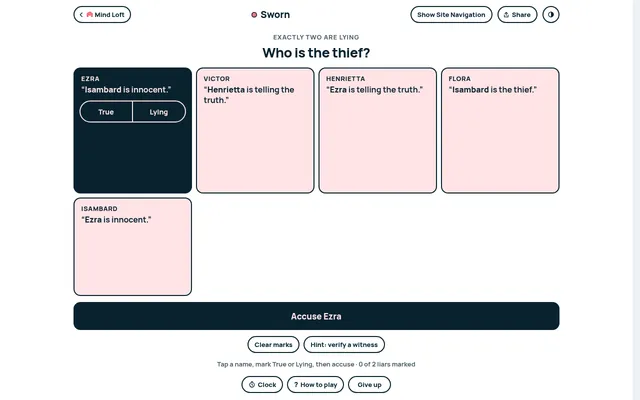
Sworn (Mind Loft)
A liars puzzle with a fixed count of lies, closer to a whodunit than to a proof.
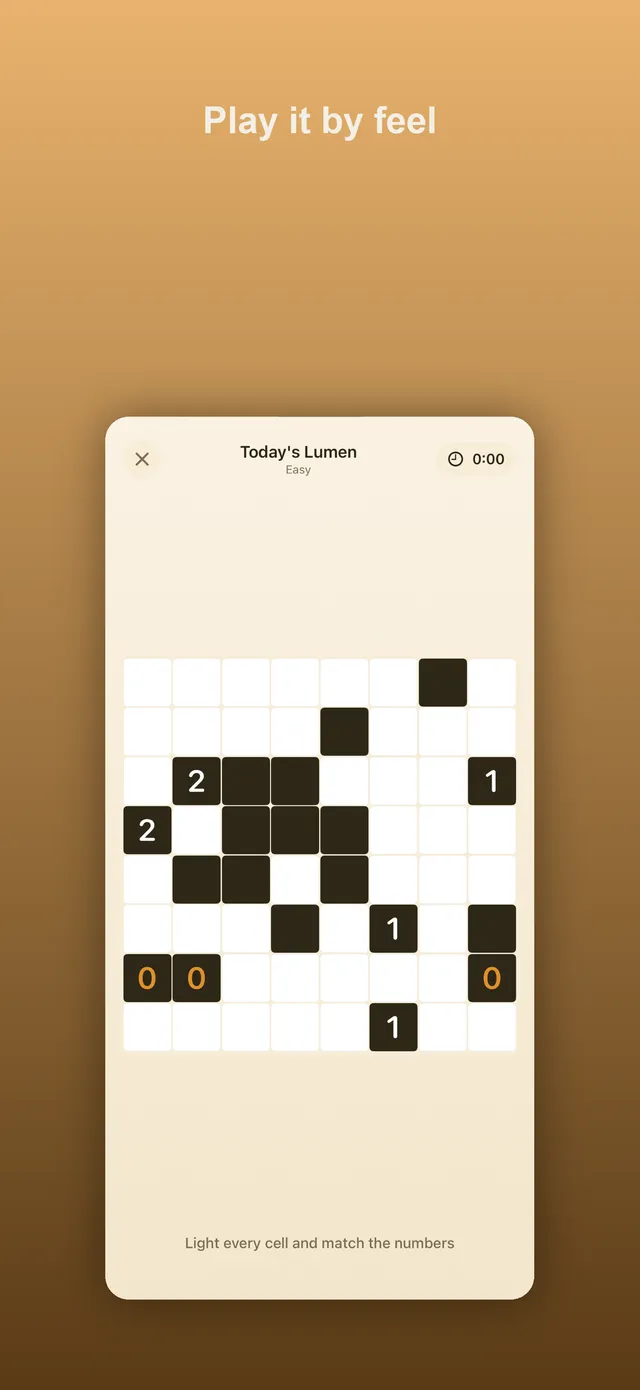
Daily Lumen
Lighting a board again, as a Light Up grid of lamps rather than rooms.

LogiCue
Also wordless at heart: you test a hidden number rule with experiments until you can name it.
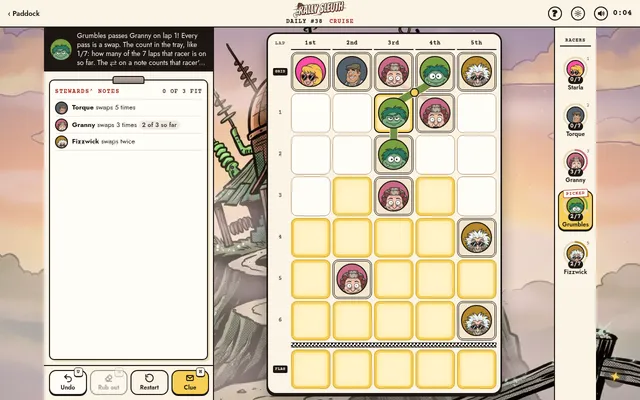
Rally Sleuth
Work out who overtook whom, lap by lap, until only one finishing order fits the Stewards' notes.
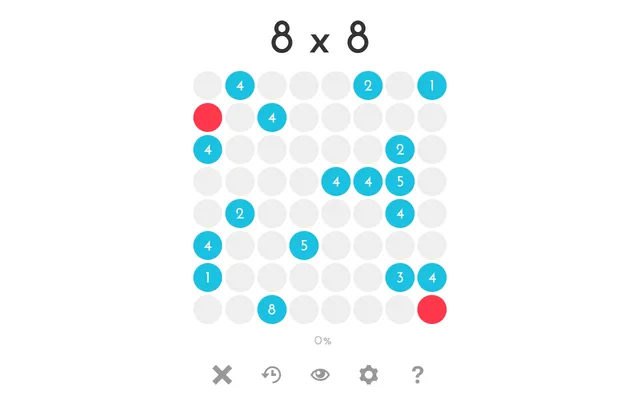
0h n0
Fill a grid of blue and red dots so every numbered blue dot sees exactly its count, with six fresh grids each…