LogiQuiz
Six multiple-choice quizzes a day whose questions are about their own answers.
Every day: A numbered, dated pack of six self-referential quizzes each day, from very easy to ultra hard, the same for every visitor. New puzzle: Once a day (packs are dated; the exact time is not stated).
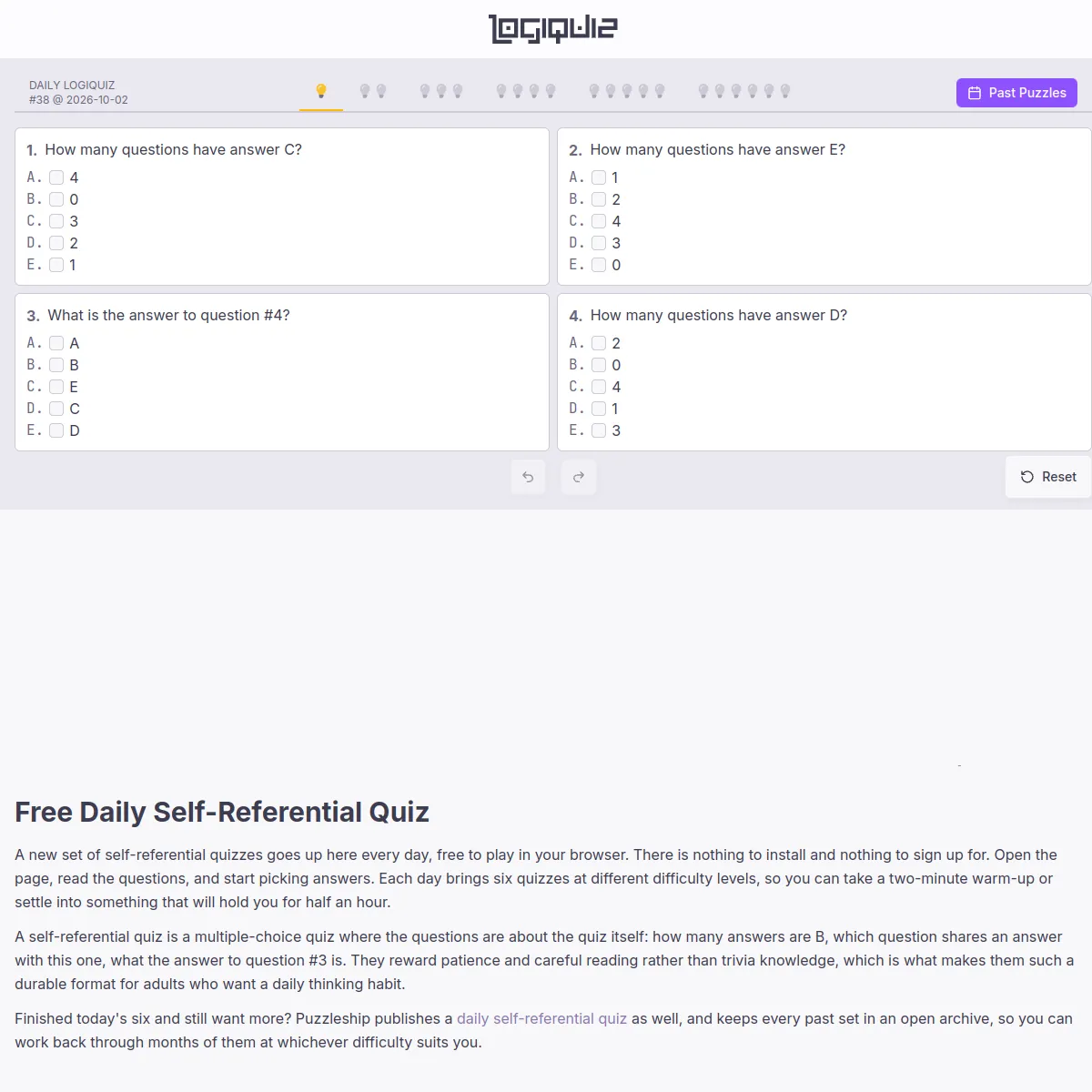
LogiQuiz publishes a daily pack of self-referential quizzes: multiple-choice questions such as 'How many questions have answer C?' whose correct answers depend on each other. Each pack has six levels, from a short warm-up to an ultra hard grid, and each quiz has exactly one consistent solution.
About LogiQuiz
A self-referential quiz looks like an ordinary multiple-choice test, but every question is about the quiz itself: how many answers are B, what the answer to question 4 is, which other question shares this one's answer. No question can be settled alone, so you reason about the whole set until only one consistent pattern of answers is left. The format was made famous by Jim Propp's Self-Referential Aptitude Test.
LogiQuiz puts up a new pack every day, labelled with a number and the date (for example #38 for 2 October 2026). The pack contains six quizzes at rising difficulty, marked with one to six light bulbs. The easy ones have four questions with direct references; the harder ones add more questions, counting rules and tangled cross-references, and can take half an hour.
The interface helps you test ideas. Click a choice once to cross it out, twice to select it and a third time to clear it. Each question card turns green when your choice agrees with your other picks and red when it contradicts them, and undo and redo buttons let you back out of a wrong hypothesis. A Past Puzzles button opens earlier packs. There is no account and nothing to install.
It suits people who like pure deduction puzzles and want something different from grid logic, with a gentle way in for newcomers.
How to play LogiQuiz
- Pick a difficulty level from the light-bulb tabs on today's pack.
- Read every question first, since each one refers to the quiz's own answers.
- Click a choice once to eliminate it, again to select it, and a third time to clear it; only one answer per question can be selected.
- Watch the colours: a card turns green when its answer is consistent with your picks and red when it is not. The quiz is solved when every card is green.
Tips
- Start with questions that constrain themselves or have only one possible answer, then follow the ripple.
- Counting questions ('How many questions have answer A?') usually narrow things down fastest once a few answers are fixed.
- Use undo to test a hypothesis several steps deep and back out cleanly if it turns red.
- Begin at the easiest level to learn the format before trying the five- and six-bulb quizzes.
Questions
What is a self-referential quiz?
A multiple-choice quiz whose questions are about the quiz's own answers, so every answer affects whether the others are right. Each quiz has exactly one consistent set of answers.
How many LogiQuiz puzzles are there each day?
Six, from very easy to ultra hard.
Do I need an account?
No. The quizzes are free in the browser with no sign-up.
Can I play earlier packs?
Yes, through the Past Puzzles button.
Games like LogiQuiz
Self-Referential Quiz (Puzzleship)
Puzzleship's daily self-referential quiz, with a long archive
Einstein Riddles (Puzzleship)
Daily deduction puzzles solved from a set of interlocking clues
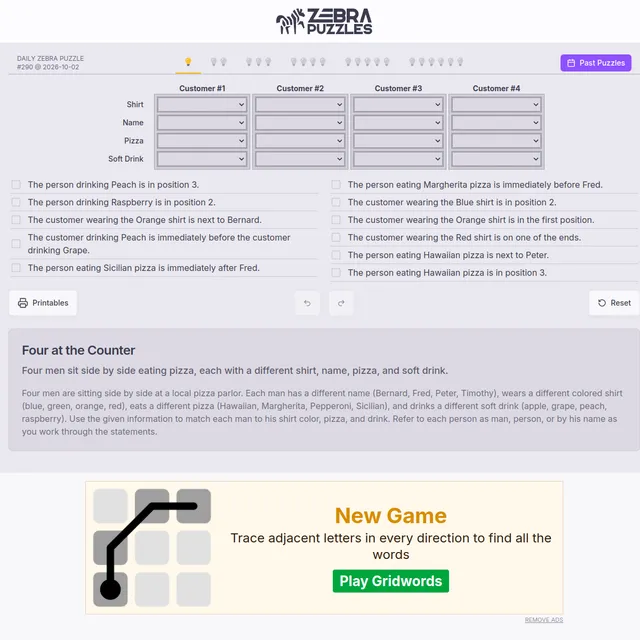
Zebra Puzzles
Classic logic-grid deduction with a daily puzzle
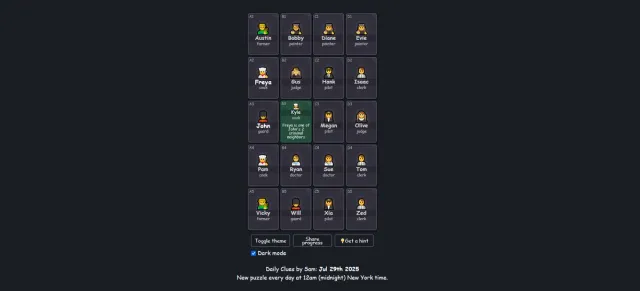
Clues by Sam
A daily deduction puzzle where each clue narrows down who is who

Murdle
Daily logic mysteries solved by pure deduction
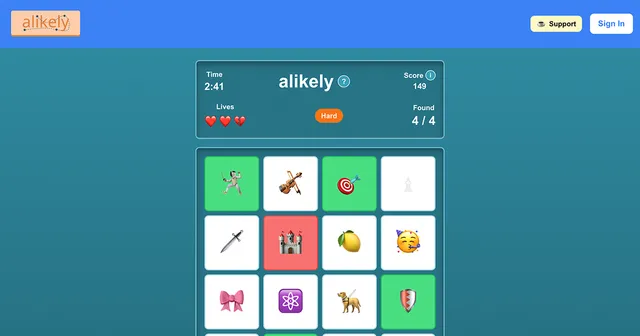
alikely
Another daily puzzle built on reasoning about statements
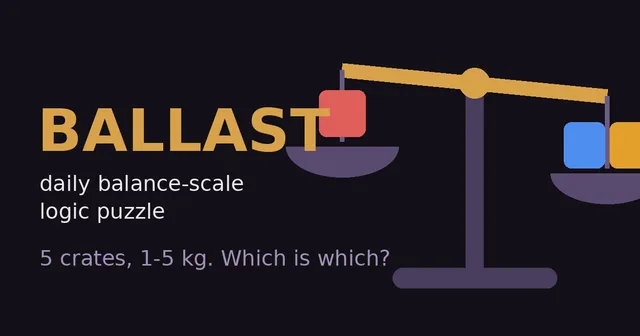
Ballast
Five crates weigh 1 to 5 kg: find which is which with as few weighings as you can.
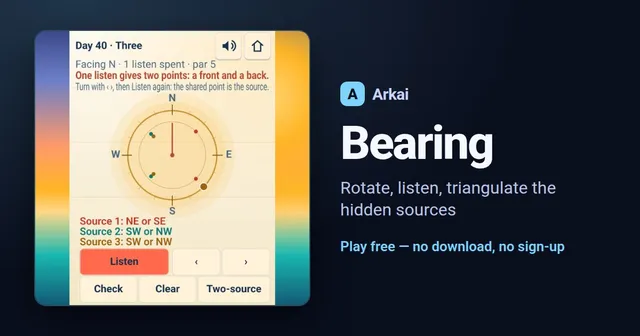
Bearing (Arkai)
Turn, listen, and triangulate two or three hidden sound sources around a 16-point compass.