Geo Sort
Rate itRank five places from largest to smallest by the day's geographic measure.
on geosort.site
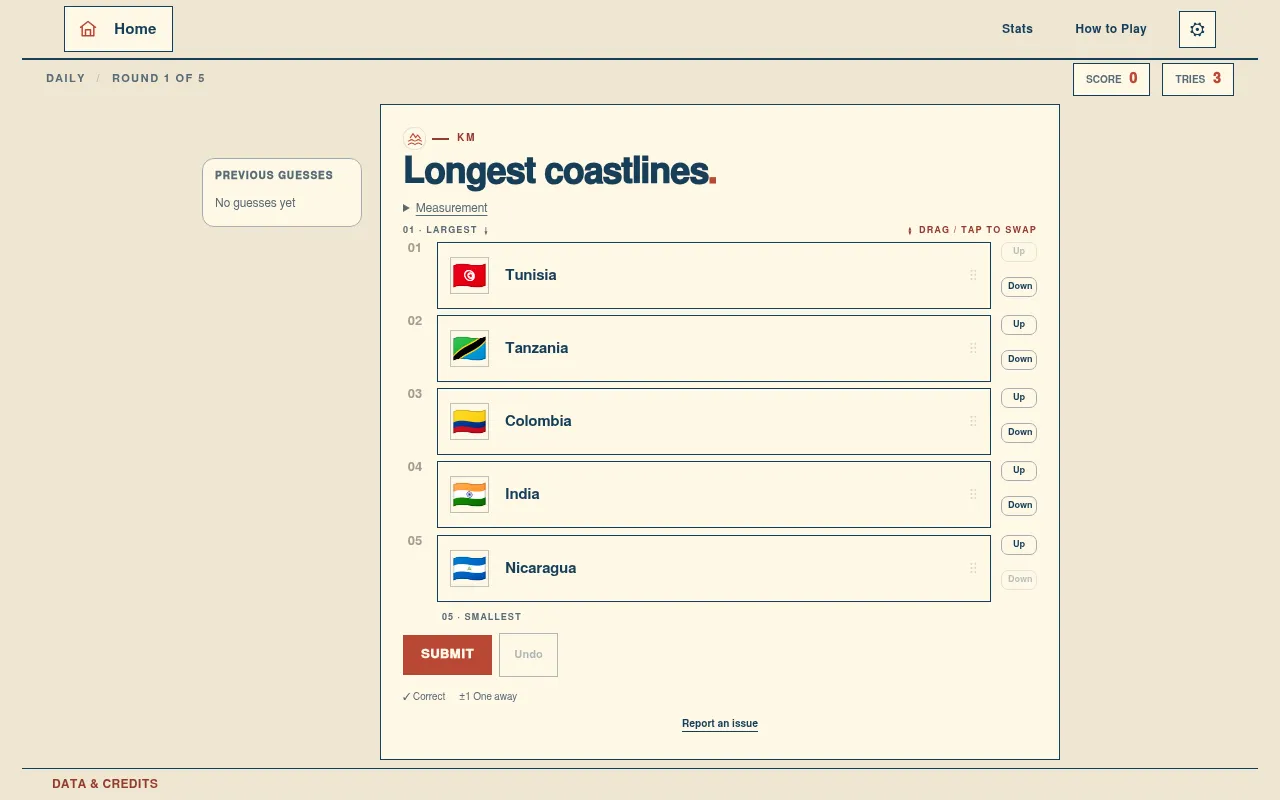
Geo Sort is a free daily geography game in the browser. Each day brings five rounds, and in each one you put five countries or cities in order by a measure such as coastline length, population or median age, with three tries per round. Correct places lock in green, near misses show in yellow, and a daily score, streak and optional leaderboard bring players back.
About Geo Sort
Geo Sort is a web game about the numbers behind the map. Each round shows a measure, for example "Longest coastlines" in kilometres, and five places with their flags. Your job is to arrange them from largest at the top to smallest at the bottom.
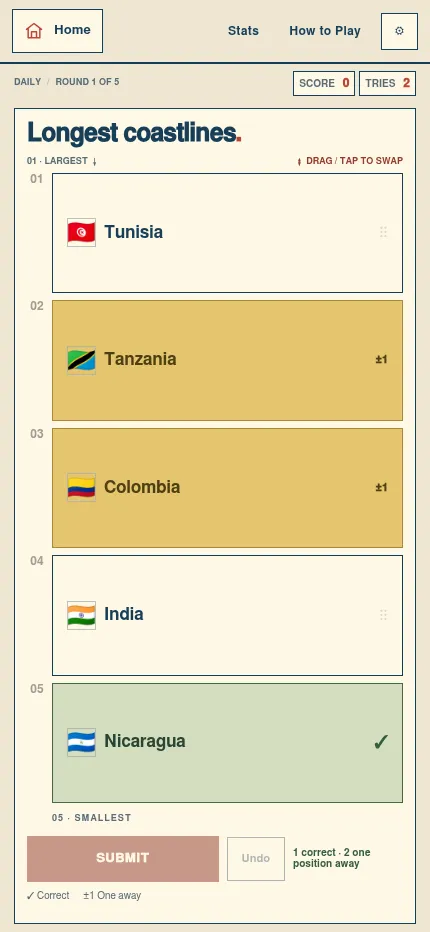
The daily game has five rounds, the same for everyone, and a new set arrives at midnight Pacific Time. Each round gives you three tries. After a submit, places in the right spot turn green and lock in place, and places one spot away are marked in yellow with a ±1 (a hint you can turn off in Settings). A solve on the first try earns 3 points, on the second 2 and on the third 1, so a perfect day is 15 points.
The measures come from twelve categories, among them population, life expectancy, country size, GDP, median age, coastline length, capital latitude, city elevation, temperature and rainfall, drawn from sources such as the World Bank and the UN. Temperature and rainfall are long-term averages, not the day's weather.
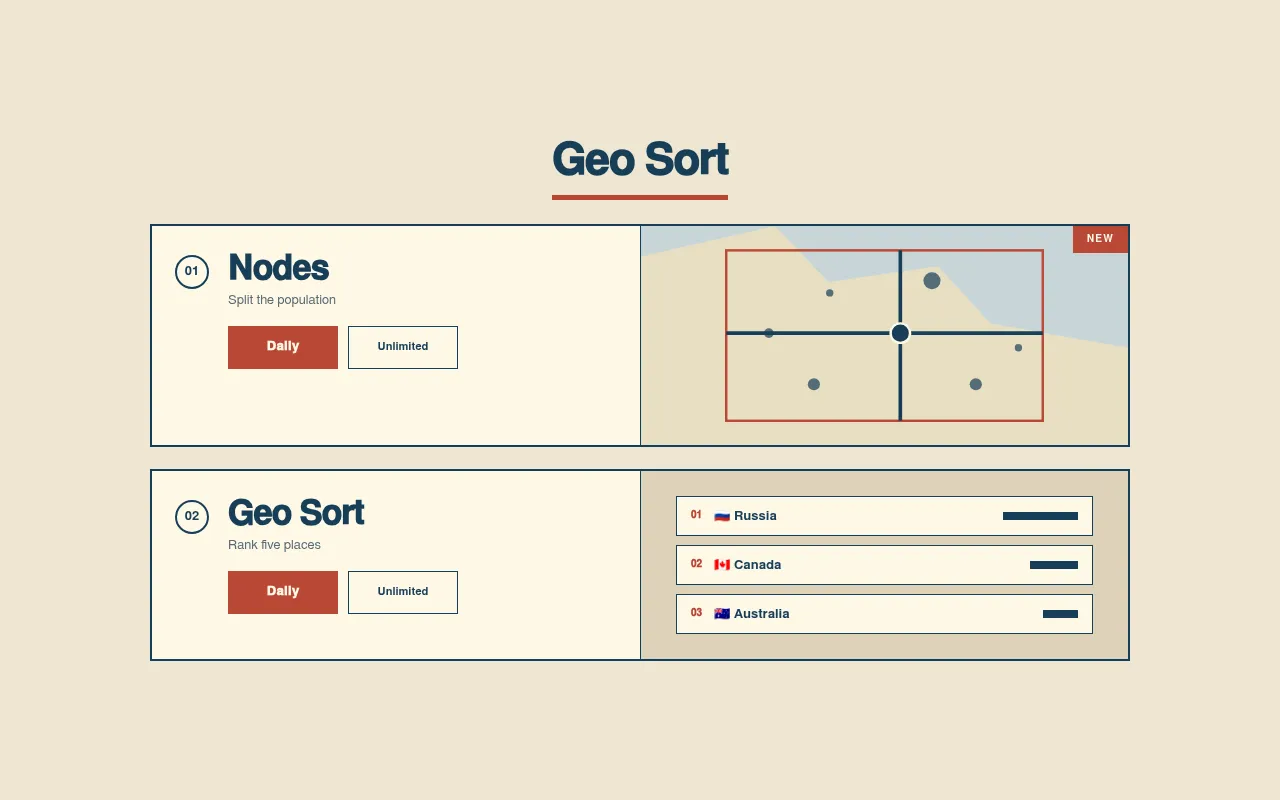
Beyond the daily set there is an Unlimited mode with fresh rounds, a stats page with your daily streak and best score, a share button for your result, and a daily leaderboard you can join by picking a username. The same site also hosts Nodes, a separate game about splitting a map's population.
Geo Sort suits players who like ranking games and geography quizzes that reward a feel for scale rather than exact recall.
How to play Geo Sort
- Open geosort.site and press Daily on the Geo Sort card.
- Read the round's measure at the top of the card, such as Longest coastlines.
- Drag the five places into order from largest at the top to smallest at the bottom, or tap two cards to swap them.
- Press Submit. Places in the right position turn green and lock; a yellow ±1 shows a place one spot away (you can turn this hint off in Settings).
- Reorder the rest and submit again. You have three tries per round, worth 3, 2 or 1 point for a solve.
- Play all five rounds, then check your score out of 15 and share it or add it to the leaderboard.
Screenshots
Tips
- Lock in the extremes first: the largest and smallest place are usually the easiest to judge.
- Turn off the one-away marker in Settings if you want a harder game with only green locks between tries.
- On a keyboard, use the arrow keys to choose a card, Space to swap and Enter to submit.
- Use Unlimited mode to practise the categories you find hard before the next daily set.
Questions
What time does Geo Sort reset?
The daily set changes at midnight Pacific Time, and the home screen shows a countdown to the next reset.
How is Geo Sort scored?
Each of the five daily rounds gives 3 points for a solve on the first try, 2 on the second and 1 on the third, for a best score of 15.
Do I need an account?
No. The daily game plays without signing up. You only choose a username if you want to join the daily leaderboard.
Where do the numbers come from?
The site credits sources such as the World Bank, the UN population and urbanization data and climate averages, with population and GDP from 2024 to 2025 figures.
Ratings and reviews
Games like Geo Sort

Geopolitix
The same idea: five rounds a day of five countries to rank by a real statistic such as GDP or working hours.
Order the Country (Quizebra)
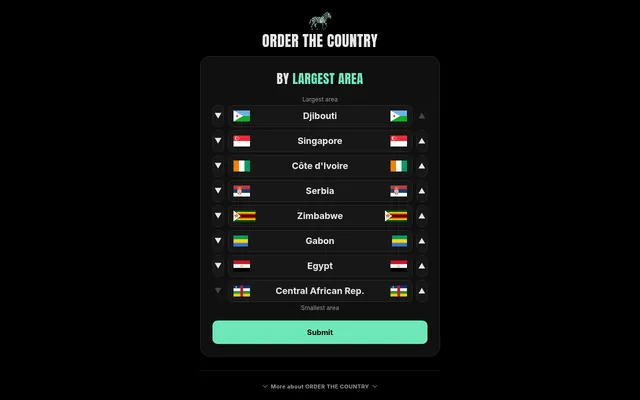
Puts eight countries in order by one measure a day, from population and area to coastline and highest peak.
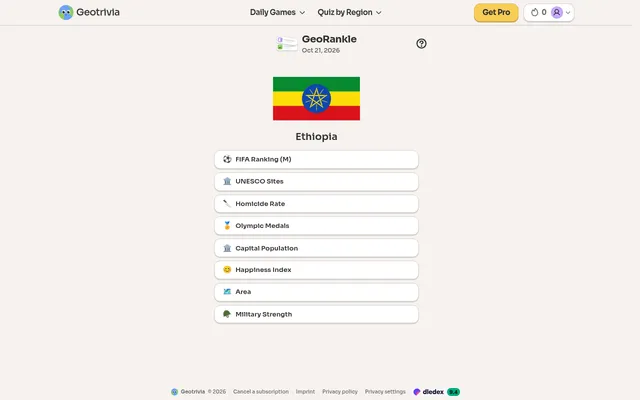
GeoRankle (Geotrivia)
Ranks countries on statistics too, placing each of eight countries in the ranking category where it does best.
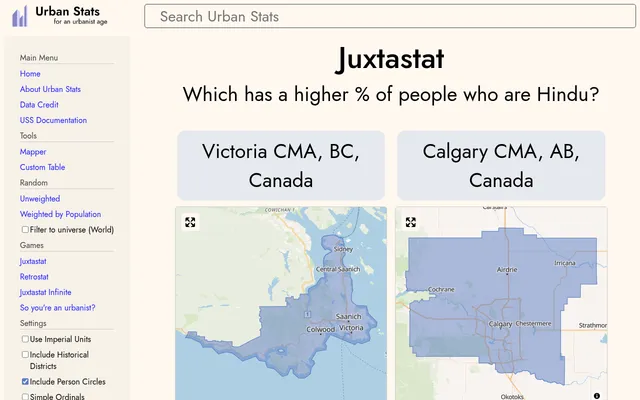
Juxtastat (Urban Stats)
Five daily questions on which of two real places has the higher figure, for players who like Geo Sort's…

Higher Lower
A shared daily run of higher or lower calls on real data, on a topic that changes each day.
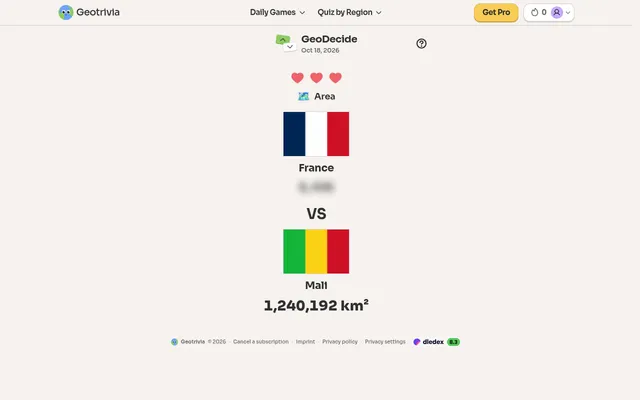
GeoDecide (Geotrivia)
Compares countries on the day's statistic with higher or lower calls over 15 turns and three lives, instead…
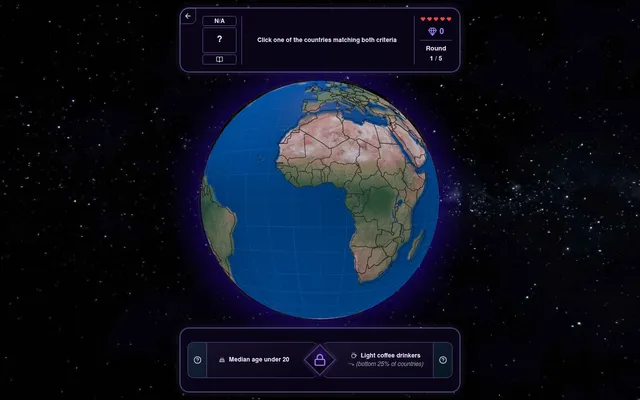
CrossMapQuest
Five daily rounds that pair a country fact with a top or bottom 25% statistic, clicked on a globe.
GeoSlice
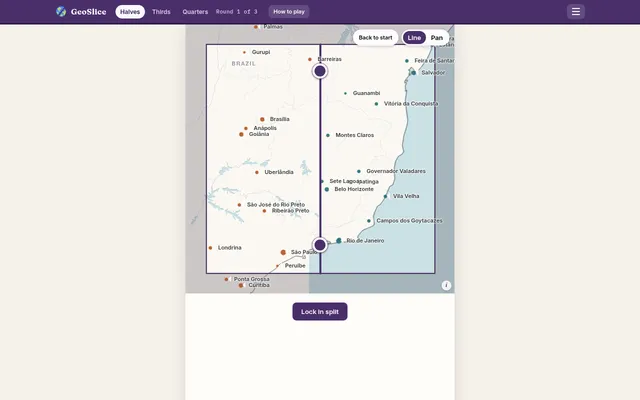
Splits a map's population with lines, close to Nodes, the other game on the Geo Sort site.